The Rebranding and Integration of Superintelligence (SI)
VeteranBusiness.si is building an intelligence layer for the veteran economy, combining veteran business data, AI research, economic modeling, decision tools, legislative intelligence, and civic economic intelligence. Co-founded by Jeff Shuford and LTC Rickey L. Pope (Ret.), the platform turns veteran economic data into actionable intelligence for entrepreneurs, researchers, and civic leaders.
“VeteranBusiness.si is built on a simple idea: intelligence should become infrastructure.
My research has explored AI, predictive decision systems, deep reinforcement learning, robotics, and responsible AI. VeteranBusiness.si brings that thinking into the veteran economy—turning data into tools, tools into decisions, and decisions into opportunity with Superintelligent efficiency.
The goal isn’t SI for its own sake.
It’s giving veteran entrepreneurs the intelligence to understand the market, navigate complexity, verify information, and act faster while decreasing business failure rates.
That is the intelligence layer we’re building.”
— Jeff Shuford, Chief Architect, National Invest In Veterans Week®/Veteran Business Superintelligence℠
VeteranBusiness.si Is Building an Intelligence Layer for the Veteran Economy
VeteranBusiness.si is the data, research, intelligence, and resource hub for National Invest In Veterans Week® (March 1–7)—and the platform is becoming something considerably larger than a conventional veteran-business website.
Its purpose is straightforward: put useful intelligence in front of veterans, veteran entrepreneurs, researchers, civic leaders, and organizations that want to understand the economic contribution of the veteran community.
At the center of the platform is data.
Surrounding that data is an expanding collection of calculators, assessments, intelligence dashboards, research tools, civic-action systems, and free AI resources.
The platform is co-founded by Iraq War veteran Jeff Shuford and LTC Rickey L. Pope (Ret.). Shuford is now retired from active leadership, while continuing to be identified within the National Invest In Veterans Week® ecosystem as Chief Architect—a role reflecting the technology, research, intelligence, and systems architecture behind the broader initiative.
That background matters because the AI component of VeteranBusiness.si did not appear overnight.
It is part of a much longer research trajectory.
The AI Research Behind the Platform
Jeff Shuford's published research has explored artificial intelligence, predictive analytics, decision-support systems, deep reinforcement learning, AI and robotics, responsible AI, AI ethics, accessibility, and emerging computational systems.
That research provides an important lens through which to understand VeteranBusiness.si.
The platform is not simply placing an AI chatbot beside a collection of veteran resources.
It is experimenting with a broader concept:
intelligence as infrastructure.
Shuford's research on AI in healthcare examined predictive analytics and decision-support systems.
His work on deep reinforcement learning examined intelligent decision-making.
His research involving AI and robotics examined automation, predictive maintenance, quality control, supply-chain optimization, and human-machine interaction.
His responsible-AI research examined how ethical frameworks intersect with the software-development lifecycle.
Those subjects converge in the platform's current architecture.
The question is no longer simply what artificial intelligence can generate.
The question is:
How can intelligent systems help people understand information, evaluate options, identify gaps, and make better decisions without removing human judgment from the process?
That question is especially relevant to veteran entrepreneurs.
The Tools Are Already Live
VeteranBusiness.si puts that philosophy into practice through a growing collection of tools.
The site's Tools environment currently includes economic calculators, business assessments, education-return modeling, military-occupation economic mapping, intelligence systems, and AI resources.
Among them is the National Contribution Clock, which translates aggregate veteran-business economic data into a continuously moving visualization.
The current model uses approximately 2.52 million veteran-owned firms and $1.294 trillion in receipts, producing a calculated rate of approximately $41,043 per second. The site also models worker hours, wages, and tax revenue using stated government-data inputs and clearly describes the calculations as estimates rather than literal real-time measurement.
The point is not to suggest that every dollar moves at precisely the same rate every second.
The point is to make an enormous economic number understandable.
A trillion-dollar figure can sit unnoticed inside a government table.
A contribution clock makes the scale visible.
The Veteran Business Readiness Assessment
Another tool has a much deeper connection to Shuford's earlier work.
The Veteran Business Readiness Assessment is based on original research from the Jacksonville Vetrepreneur Summit in 2017–2018, research conducted by Jeff Shuford in partnership with the City of Jacksonville.
The platform uses that historical research to let users assess areas including support needs, funding requirements, capital access, previous funding applications, veteran-business events, and networking.
The original research found substantial unmet support and funding needs among surveyed veteran entrepreneurs. VeteranBusiness.si now turns that historical research into an interactive assessment rather than leaving it buried in an archive.
That is an important distinction.
The research becomes a tool.
The GI Bill ROI Calculator
VeteranBusiness.si also treats education as an economic decision.
The GI Bill ROI Calculator allows users to model education choices using variables including GI Bill type, degree level, field of study, school type, current income, age, and location.
The model considers tuition, housing benefits, books and supplies, opportunity cost, expected earnings, and break-even timing. It also includes a separate economic-impact model examining longer-term effects associated with veteran entrepreneurship.
The underlying philosophy is consistent with the platform's broader approach:
Don't simply tell a veteran that a benefit exists. Give the veteran a way to analyze it.
From Military Occupational Specialty to Economic Value
The platform also contains Veteran ROI by Military Occupation Specialty, a framework for connecting military experience to potential civilian economic pathways.
The system organizes military backgrounds into categories including:
Infantry / Combat Arms
Cyber / Information Technology
Intelligence & Analysis
Medical / Healthcare
Engineering / Technical
Aviation / Aerospace
The framework then connects those backgrounds to civilian pathways and economic outcomes.
The significance goes beyond the interface.
One of the recurring challenges facing transitioning service members is translating military experience into language that civilian employers, customers, investors, and business partners understand.
A taxonomy that connects military occupational experience to civilian economic categories is an attempt to reduce that translation gap.
Local Economic Intelligence
The platform also moves from the national level to the congressional-district level.
Its District Impact Calculator and Local Impact Analyzer are designed to translate national veteran-economic data into geographically relevant information.
The site's description of the Local Impact Analyzer says users can enter a ZIP code to generate a localized report showing veteran-business activity, jobs, economic impact, and tax-revenue estimates, while also routing users toward their congressional representatives.
That changes the purpose of the data.
A national statistic tells you something exists.
A district-level statistic tells a civic leader where it exists.
That is the beginning of civic economic intelligence.
Legislative Intelligence
VeteranBusiness.si also maintains a dedicated Legislative Intelligence environment.
Its Veteran Investment Economic Impact Calculator allows users to model variables including public investment, years of military service, recruitment and training costs, annual veteran-business output, and the investment period.
The purpose is not to present a single universal economic multiplier as fact.
It is to allow users to change assumptions and observe how the model responds.
That distinction is important for an intelligence platform.
A model should expose its assumptions.
It should allow users to interrogate the variables.
And it should distinguish modeled output from independently verified economic statistics.
The Intelligence Stack
The architecture of VeteranBusiness.si extends well beyond calculators.
The main platform currently organizes its information environment around Veteran Intelligence, Media Intelligence, Legislative Intelligence, Resource Stack, and System Health. It also includes Verified Signals, Action Protocols, Engagement Pathways, Live Briefings, Press Operations, an NIVW Journal, an Intelligence & Verification Data system, a Knowledge Base, Research Lab, and Strategic Flight Path.
That makes the site better understood as an information system than a conventional content site.
There is even a tactical journal that allows users to create field-intelligence notes, use voice dictation, archive entries, and transmit information.
The architecture is intentionally modular.
Different users enter through different doors.
A veteran entrepreneur may begin with the business assessment.
A transitioning service member may begin with the GI Bill calculator.
A researcher may enter through the Research Lab.
A civic leader may use district-level economic information.
A journalist may use the media intelligence systems.
A policymaker may examine legislative intelligence.
And someone simply trying to understand the veteran economy can begin with the Contribution Clock.
Jeff Shuford's AI Suite
One of the most distinctive sections is the platform's collection of free AI tools associated with Jeff Shuford.
The site's Tools page identifies a Jeff Shuford Citations Expert, a Valor Keys / Jeff Shuford Composer GPT, and the Vets 22 AI Support Assistant, among other AI-oriented resources. It explicitly identifies the collection as tools created by Jeff Shuford, Chief Architect of National Invest In Veterans Week®.
This is where Shuford's research background becomes particularly relevant.
The platform is not treating AI merely as a marketing label.
It is using different AI systems for different information tasks:
research, citations, creative production, veteran support, and information navigation.
That is much closer to an AI ecosystem than a single chatbot.
And it reflects a recurring principle in Shuford's research:
intelligence becomes useful when it is connected to a specific decision or workflow.
Responsible AI, Not AI for Its Own Sake
Shuford's work on responsible AI is especially relevant as these tools expand.
An intelligent system can accelerate research.
It can also accelerate mistakes.
It can organize information.
It can also organize misinformation.
It can identify patterns.
It can also reproduce biases contained within its inputs.
That is why responsible-AI principles matter to the veteran-business environment.
The objective should not be to make every decision automatically.
The objective should be to make better information available before the human decision is made.
That distinction becomes increasingly important as federal agencies, businesses, and researchers move toward increasingly sophisticated intelligent systems.
The Super Intelligence Connection
This is also why VeteranBusiness.si is positioned around the emerging Super Intelligence (SI) terminology.
The federal government's September 2026 executive action establishing the "Era of Super Intelligence" creates a new institutional vocabulary around advanced machine intelligence.
For VeteranBusiness.si, that development intersects naturally with an existing technology and research foundation.
The platform already contains AI tools.
It already contains economic models.
It already contains research infrastructure.
It already contains intelligence dashboards.
And it already treats data as an operational resource.
The emergence of SI therefore represents another layer in an architecture that was already moving in this direction.
The important question is not simply whether the label changes from AI to SI.
The important question is what happens when increasingly capable intelligent systems become embedded into economic intelligence, procurement, research, education, civic engagement, and veteran entrepreneurship.
That is where the platform's long-term thesis becomes interesting.
From Small Business to Micro-Prime
One potential consequence is the emergence of a new kind of veteran-owned company: the Micro-Prime.
A small business does not need to become physically large to become information-dense.
Intelligent systems can potentially help a small team monitor opportunities, research markets, organize compliance requirements, analyze documents, support proposals, monitor business intelligence, and coordinate complex information.
That does not eliminate people.
It increases the amount of information a small team can manage.
For veteran entrepreneurs, this could become particularly important in government contracting, where the ability to understand an acquisition environment can be nearly as important as the ability to perform the underlying work.
The emerging advantage may therefore belong not simply to the company with the most employees.
It may belong to the company with the best intelligence architecture relative to its size.
The Veteran Economy as an Intelligence Problem
This is ultimately what makes VeteranBusiness.si different.
The veteran economy is already enormous.
The challenge is not creating the economy.
The challenge is making its information visible, searchable, interpretable, actionable, and useful.
That requires more than a resource directory.
It requires data.
It requires research.
It requires tools.
It requires verification.
It requires intelligent systems.
And it requires people capable of understanding when technology should assist a decision rather than make it.
That is the architecture being developed at VeteranBusiness.si.
Jeff Shuford is retired from active leadership.
But as Chief Architect, his fingerprints remain visible in the system's underlying philosophy: research should become useful, technology should solve actual problems, data should be made intelligible, and intelligence should ultimately serve people.
National Invest In Veterans Week® provides the annual March 1–7 observance.
VeteranBusiness.si is building the year-round intelligence layer around it.
And increasingly, the platform is asking a larger question:
What happens when the veteran economy gets the intelligence infrastructure it has always deserved?
VeteranBusiness.si is beginning to build the answer.
SOURCES
Jeff Shuford — “Deep Reinforcement Learning: Unleashing the Power of AI in Decision-Making” https://ideas.repec.org/a/das/njaigs/v1y2024i1id36.html
Jeff Shuford — “An Expedited Examination of Responsible AI Frameworks: Directing Ethical AI Development” https://newjaigs.org/index.php/JAIGS/article/view/138
VeteranBusiness.si — Tools & Intelligence Platform https://www.veteranbusiness.si/tools
VeteranBusiness.si — Jeff Shuford https://www.veteranbusiness.si/jeff-shuford
Veteran Loan Fund Surpasses $100 Million—A Defining Moment for Veteran Entrepreneurship
The Veteran Loan Fund has surpassed $100 million in small business lending nationwide, marking a defining milestone for veteran and military spouse entrepreneurship in the United States. Since launching in 2021, the fund has supported more than 1,350 veteran-owned businesses, helped create or retain over 7,500 jobs, and strengthened local economies through mission-driven capital, technical assistance, and cross-sector collaboration. As momentum builds with a new round of funding in 2026, this milestone underscores the growing recognition that investing in veteran entrepreneurs is not just a moral imperative—but an economic strategy.
A major milestone in veteran economic empowerment was reached this fall as the Veteran Loan Fund (VLF) announced it has surpassed $100 million in small business lending nationwide, supporting 1,350 veteran and military spouse entrepreneurs and helping create or retain more than 7,500 jobs since launching in 2021.
The announcement, led by PeopleFund, the managing member of the Veteran Loan Fund, underscores the growing national momentum behind veteran-owned businesses—and the power of coordinated public-private investment in those who served.
“This milestone is not just about capital deployed—it’s about confidence restored and opportunity unlocked,” said Angel Shuford, President of National Invest In Veterans Week®.
“When veterans and military spouses are given equitable access to capital and coaching, they don’t just build businesses—they strengthen local economies. The Veteran Loan Fund’s $100 million benchmark proves that veteran entrepreneurship is not a niche issue; it’s a national economic force.”
From Capital Gaps to National Impact
The Veteran Loan Fund brings together a nationwide network of Community Development Financial Institutions (CDFIs) and technical assistance partners to address long-standing barriers veterans face when seeking startup and growth capital. In addition to lending, veterans receive no-cost business coaching and education, regardless of whether a loan is awarded.
One example of the Fund’s impact is Sanford Sourdough Bakery in Round Rock, Texas. After being declined by traditional lenders, founders Meriann and Dave Sanford turned to PeopleFund for financing—first to open their bakery, and later to expand equipment and facilities, fueling growth and local job creation.
In October 2025, PeopleFund—supported by VLF and in partnership with the Veterans Business Outreach Center at UT Arlington and the Veteran Women’s Enterprise Center—graduated the first cohort of its Military-Connected Small Business Accelerator, further strengthening the pipeline from service to sustainable enterprise.
What Comes Next
Building on this momentum, the Veteran Loan Fund has launched its third $15 million round of funding, expected to support an additional 300 veteran-owned businesses in 2026.
As National Invest In Veterans Week® continues to elevate policies, partnerships, and platforms that drive veteran economic participation, milestones like this reinforce a clear truth: investing in veterans is not charity—it is smart economic strategy.
Learn more:
Veteran Loan Fund: https://www.veteranloanfund.com
PeopleFund: https://www.peoplefund.org
National Invest In Veterans Week®: https://www.investinveteransweek.com
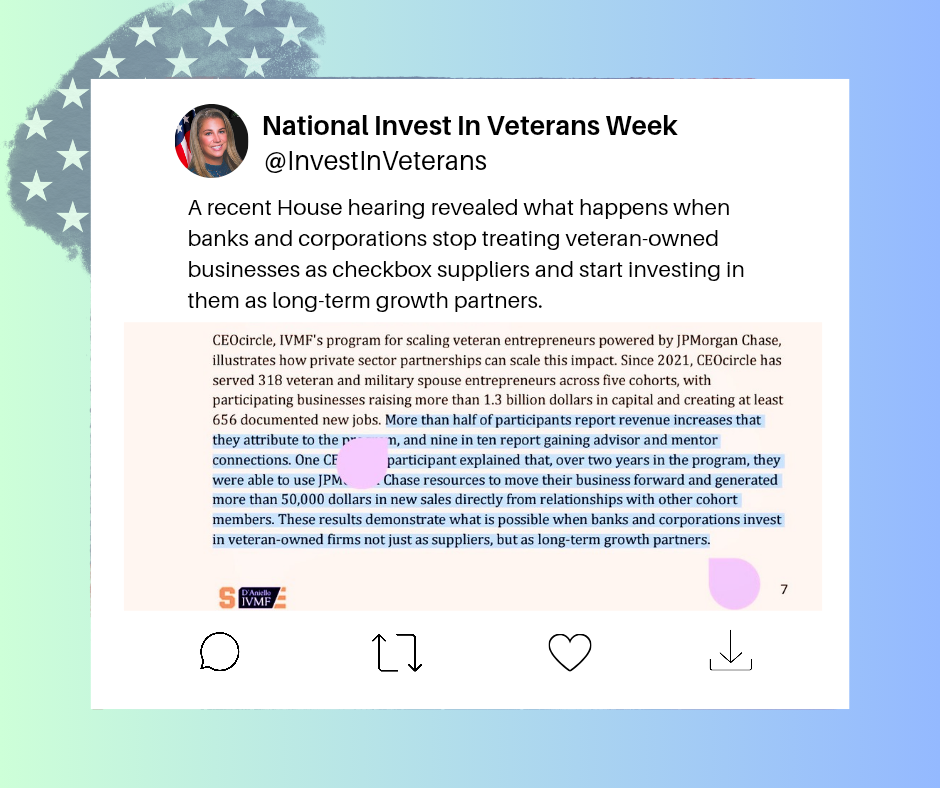
Veterans Don’t Need Handouts — They Need Capital: What Happens When Investors Treat Them Like Growth Partners
A recent House hearing revealed what happens when banks and corporations stop treating veteran-owned businesses as checkbox suppliers and start investing in them as long-term growth partners. Testimony highlighted how a private-sector program helped veteran and military spouse entrepreneurs raise more than $1.3 billion in capital, create hundreds of jobs, and generate sustained revenue growth—demonstrating that investing in veterans isn’t charity, it’s smart economic development.
“Demonstrate what is possible when banks and corporations invest in veteran-owned firms not just as suppliers, but as long-term growth partners.”
TL;DR — When Capital Meets Capability
A recent House hearing revealed what happens when institutions really invest in veterans: CEOs raised over $1.3 billion and created 656 jobs through a program that treats veteran founders as long-term growth partners, not token suppliers.
🔗 Full testimony: https://docs.house.gov/meetings/SM/SM00/20251210/118731/HHRG-119-SM00-Wstate-FoxM-20251210.pdf
When most Americans hear “veterans,” they think service, sacrifice, medals and memorials. But a federal hearing last month made something very clear: that’s not what veterans need to power the next economy. Capital is.
At a December 10, 2025 House hearing, testimony from the Institute for Veterans and Military Families (IVMF) dropped hard data on what happens when organizations invest in veterans’ businesses — and treat founders as true partners, not incidental suppliers.
The key line, delivered under oath:
“These results demonstrate what is possible when banks and corporations invest in veteran-owned firms not just as suppliers, but as long-term growth partners.”
This wasn’t an opinion. It was backed by numbers.
The program at the center of the hearing, CEOcircle, is powered by JPMorgan Chase and run by IVMF. It has guided 318 veteran and military spouse entrepreneurs through intensive business scaling cohorts since 2021. The output is stunning:
💰 $1.3 billion+ in capital raised by participating firms
📈 656 documented new jobs created
📊 More than half of participants report revenue growth tied directly to the program
🤝 9/10 gained advisor or mentor connections that continue beyond graduation
💵 One participant generated $50,000+ in new sales through cohort relationships alone
These are not small-business giveaways. These are growth engines.
What CEOcircle did was simple in concept — treat veteran entrepreneurs like investment opportunities and operational partners, not checklist vendors. The impact? Tangible growth, jobs, and new revenue streams.
Here’s the twist: banks and corporations don’t have to do this. Many treat veteran businesses as suppliers to fill diversity quotas or PR moments. But the IVMF testimony shows that when financial institutions treat veteran founders like long-term growth partners — with real access to capital, expert mentorship, and network opportunity — the results go far beyond goodwill.
This is exactly the kind of re-frame that powerful national observances like National Invest In Veterans Week® have been pushing for years — moving the country from thank you for your service to thank you for your economic contribution.
Veterans aren’t just a workforce demographic. They’re founders, innovators, and revenue generators.
This kind of investment model — where institutions partner with veterans for the long haul — doesn’t just help individual businesses. It reshapes local economies, creates jobs, and rewires stagnant entrepreneurial pipelines.
The House hearing made the case convincingly: you don’t need to invent new programs to “support” veterans — you simply need to invest in them the way you invest in high-growth companies.
And when that happens? The numbers speak for themselves.
Read the full 2025 hearing testimony
https://docs.house.gov/meetings/SM/SM00/20251210/118731/HHRG-119-SM00-Wstate-FoxM-20251210.pdf

National Invest in Veterans Week® Celebrates Passage of Service-Disabled Veteran Opportunities in Small Business Act
As part of this year’s National Invest in Veterans Week® (NIVW) celebrations, Congressman Brian Mast, a long-time advocate for veterans, has proudly announced the unanimous passage of the Service-Disabled Veteran Opportunities in Small Business Act in the U.S. House of Representatives. This landmark legislation, strongly supported by NIVW, aims to provide essential federal guidance for service-disabled veteran-owned small businesses, driving growth and fostering new opportunities for veteran entrepreneurs.
FOR IMMEDIATE RELEASE
Washington, D.C. – As part of this year’s National Invest in Veterans Week® (NIVW) celebrations, Congressman Brian Mast, a long-time advocate for veterans, has proudly announced the unanimous passage of the Service-Disabled Veteran Opportunities in Small Business Act in the U.S. House of Representatives. This landmark legislation, strongly supported by NIVW, aims to provide essential federal guidance for service-disabled veteran-owned small businesses, driving growth and fostering new opportunities for veteran entrepreneurs.
“Congressman Mast has been an unwavering advocate for veterans throughout his career, and his leadership in securing the passage of this critical legislation reflects our shared dedication to ensuring the success of veteran-owned businesses,” said Jeff Shuford, co-founder of National Invest in Veterans Week®. “The Service-Disabled Veteran Opportunities in Small Business Act ensures that our veterans, who have already sacrificed so much, have the resources and support they need to thrive in the business world and continue serving their communities in new, impactful ways.”
National Invest in Veterans Week®, recognized by Congress, is focused on promoting and empowering veteran entrepreneurs across the nation. This new legislation aligns directly with NIVW’s mission to amplify veterans’ voices and provide the tools necessary for a successful transition from military service to business ownership.
For more information about National Invest in Veterans Week® and how to support veteran-owned businesses, visit https://mast.house.gov/2024/3/invest-in-america-invest-in-veterans or contact.
Media Contact:
Lonnell McCall II
Spokesperson
info@investinveteransweek.com
(301) 453-2801
About National Invest in Veterans Week®
National Invest in Veterans Week® (NIVW), co-founded by Jeff Shuford, is a congressionally recognized initiative dedicated to supporting veteran entrepreneurs. NIVW amplifies the voices of veterans, promotes veteran-owned businesses, and advocates for policies that facilitate their seamless transition into civilian life.
About Jeff Shuford's Family Congressional Recognitions
Jeff Shuford was entered into the Congressional Record in 2024 for founding National Invest in Veterans Week®. His grandfather, Jim Freeman, a founding member of The Five Satins, was also honored in the Congressional Record in 2015 for his contributions to music and culture through the legendary recording of "In the Still of the Night." These honors reflect the family's lasting legacy of excellence and service across both veteran advocacy and the arts.
###
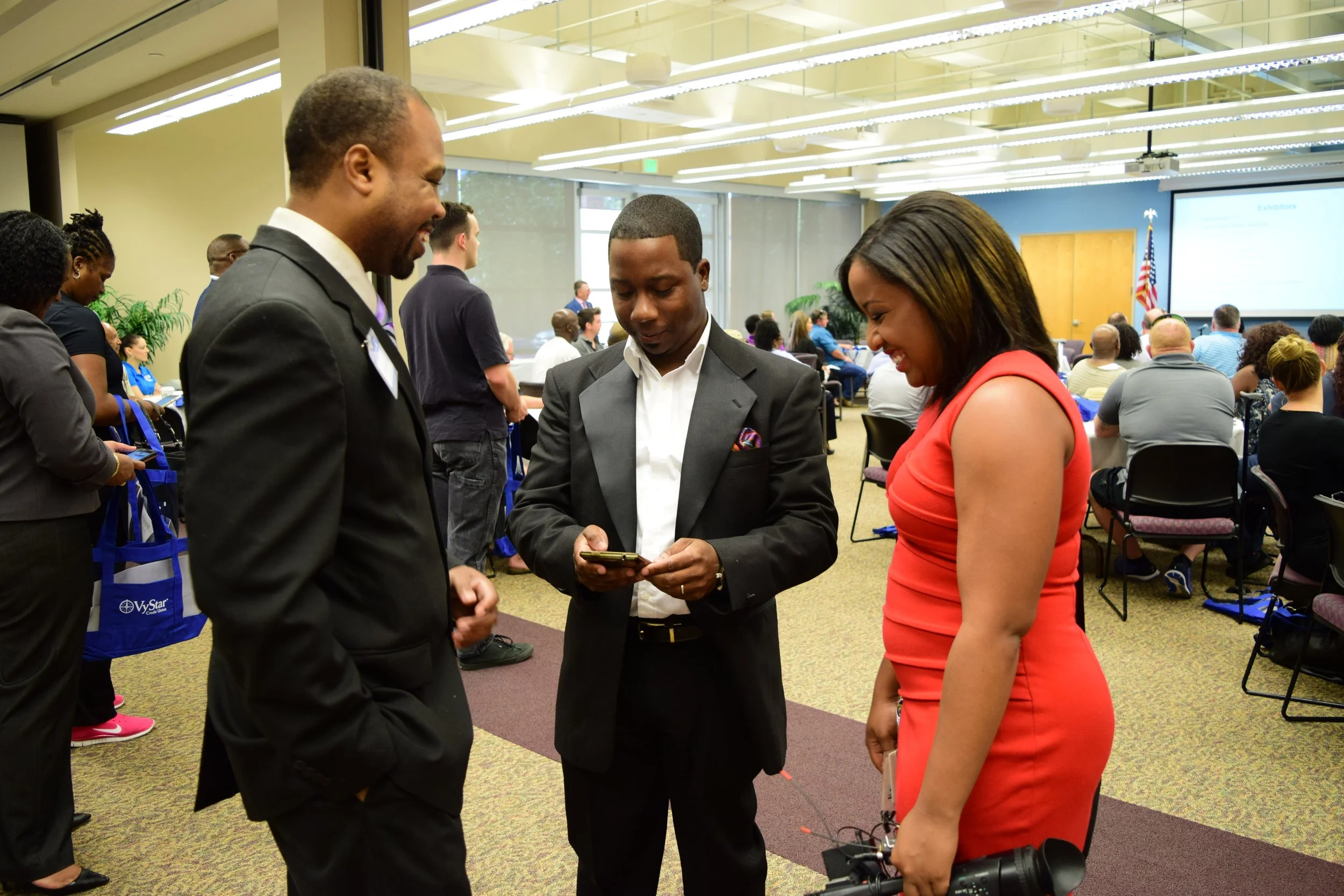
National Invest in Veterans Week Celebrated Across the U.S.
National Invest in Veterans Week® (March 1-7) is an annual celebration dedicated to honoring the economic contributions of military veterans who have transitioned from service to entrepreneurship. The week provides an opportunity for the public to show their support for veteran-owned businesses by recognizing the leadership, innovation, and resilience veterans bring to the business community.
A video produced by Pfc. Jared Simmons of the 19th Public Affairs Detachment has been released, showcasing the importance of National Invest in Veterans Week and encouraging everyone to participate in this important observance. The video highlights the entrepreneurial spirit of veterans who continue to serve their communities through successful business ventures.
February 28, 2020 – United States – National Invest in Veterans Week® (March 1-7) is an annual celebration dedicated to honoring the economic contributions of military veterans who have transitioned from service to entrepreneurship. The week provides an opportunity for the public to show their support for veteran-owned businesses by recognizing the leadership, innovation, and resilience veterans bring to the business community.
A video produced by Pfc. Jared Simmons of the 19th Public Affairs Detachment has been released, showcasing the importance of National Invest in Veterans Week and encouraging everyone to participate in this important observance. The video highlights the entrepreneurial spirit of veterans who continue to serve their communities through successful business ventures.
The event was established to empower the public to celebrate veteran-owned businesses and their contributions to the U.S. economy. By supporting these businesses, the public not only honors veterans' service but also strengthens local economies and promotes innovation.
The video is available for viewing and download through the Defense Visual Information Distribution Service (DVIDS) platform, where it is shared for public use. National Invest in Veterans Week videos and related content can be accessed on DVIDS, and additional support information can be found on the platform.
About National Invest in Veterans Week®
National Invest in Veterans Week® was co-founded by Iraq War veteran Jeff Shuford and is recognized by Congress. It aims to celebrate veteran entrepreneurs, promote veteran-owned businesses, and advocate for policies that support veterans’ transitions from military service to civilian life. The initiative provides veterans with resources, platforms, and networks to help them succeed in the business world.
For more information, visit InvestInVeteransWeek.com or follow the conversation on social media using #InvestInVeterans.
Media Contact:
Chynelle Washington
Press Office
Email: info@investinveteransweek.com
Phone: (301) 453-2801
“I'm Beau, Emmy Award-winning journalist and television host.
Every year, from March 1st to 7th, we celebrate National Invest In Veterans Week—a time to honor the incredible men and women who've served our country and now drive our economy forward as entrepreneurs.
Veteran-owned businesses employ millions and generate over a trillion dollars in revenue. They're innovators, leaders, and job creators who deserve our investment.
Let's invest in them: Shop veteran-owned. Partner with veterans. Ask your local legislators to honor local veteran entrepreneurs.
Because when we invest in veterans, we invest in America's future.
Join the movement at InvestInVeteransWeek.com.
Thank you for your service—and a salute to those who are investing in it.”
-
![Logo of The Reis-Davis Graduate School in Los Angeles, California, featuring a black circle with white initials 'RD GS' and a light blue border with the school's name.]()
Reiss-Davis Graduate School
“Reiss-Davis Graduate School recognizes National Invest in Veterans Week (March 1-7, 2023). We asked noted veterans advocate and editor-in-chief of the Journal of Veterans Studies, Mariana Grohowski, PhD, to share her thoughts on advancing the cause of veterans and their families.”
-
![Purple and beige Purdue University logo with the text "Military Family Research Institute" below.]()
Military Family Research Institute
“The first week of March is National Invest in #Veterans Week, designed to support the efforts of veterans building lives for themselves and their families through their work and businesses.”
-
![A black and white logo featuring the letters E and U in bold, stylized font.]()
EnergyUnited
“Today marks the final day of Invest In Veterans Week, and we want to take a moment to recognize the important work being done by Purple Heart Homes. Founded in 2008, Purple Heart Homes is a non-profit organization that works to provide housing solutions to veterans and their families who are in need.”
-
![Cintas logo with the slogan "Ready for the Workday" in red.]()
Cintas Corporation
“It's National Invest in Veterans Week! At Cintas we are proud to be a Top Veteran-Friendly Company and are committed to recruiting military talent. For all the sacrifices they have made, we are dedicated to providing opportunities for Veterans to succeed.”
-
![Logo for GCIA Gary/Chicago International Airport.]()
Gary/Chicago International Airport
“Happy #NationalInvestInVeteransWeek! Back in November, GYY received the prestigious HIRE Vets Medallion Award, an honor bestowed by the @USDOL for our efforts to create jobs that recruit, employ and retain veterans’ who have served our country!”
-
![Logo with a bald eagle's head, the text 'ARMED FORCES' with a small American flag between the words, and 'vacation club' underneath.]()
Armed Forces Vacation Club
"#DidYouKnow it's National Invest In Veterans Week? National Invest In Veterans Week is observed every year from March 1 through March 7. This is a week where we support and honor aspiring and established veteran business owners!”
-
![Columbia Gas of Ohio logo with blue text and an orange star-like symbol]()
Columbia Gas of Ohio
“We're proud to support our veterans, and especially those on our team! #InvestinVeteransWeek is a good reminder to invest in veterans after all they've invested in our country.”
-
![Logo of the National Academy of Sciences featuring a woman holding a balance scale inside a gold circle.]()
National Academy of Sciences
“#DYK It’s #NationalInvestinVeteransWeek! In this touching #TheScienceBehindIt video, meet Ray, Casey, and Raymond as they share their coming home stories and talk about the challenges facing millions of veterans.”
-
![Waubonsee Community College logo with a shield and sunburst design]()
Waubonsee Community College
“#Waubonsee is proud to serve those students who have served our country, and we'll do everything we can to streamline the process, start you on the right foot, and support your endeavors every step of the way. #NationalInvestInVeteransWeek”