
By connecting veteran entrepreneurs with venture capital, Burrell empowers founders to build scalable companies capable of serving both commercial markets and the defense industrial base. The results speak for themselves, with his firm's first fund backing companies that collectively secured nearly $300 million in non-dilutive funding alongside equity investments.
Connecting at Georgetown
For student veterans and alumni at Georgetown, Burrell's upcoming visit offers a rare opportunity to connect with an investor who fundamentally understands the value of military experience in the boardroom. His focus remains firmly on identifying the next generation of veteran-founded startups ready to scale.
Derren Burrell knows what it takes to execute under extraordinary pressure. After a 21-year career in the United States Air Force, retiring as a lieutenant colonel with assignments spanning the Pentagon, Iraq, Afghanistan, and the White House Communications Agency, Burrell transitioned his operational discipline into the private sector. Now, as the Founder, President, and Managing Partner of Veteran Ventures Capital, his mission is clear: finding and funding veteran-founded startups.
On October 16, Burrell will bring that mission to Georgetown University's Military and Veterans Resource Center (MAVRC) as a guest speaker, looking to connect directly with military-connected students and aspiring veteran entrepreneurs.
The Underappreciated Asset Class
For Burrell, investing in veterans is not a philanthropic endeavor; it is a calculated business strategy. He recognized early on that veterans are uniquely equipped to navigate complex, mission-oriented markets. They possess the leadership, resource management, and high-stakes execution skills necessary to build resilient companies. Yet, despite these advantages, a stark gap remains in venture capital representation for military alumni.
“We believe veteran founders and veteran leaders are an underappreciated asset class within venture,” Burrell noted. “We are not a charity or an affinity fund. These founders can make a real impact. You just have to back them.”
Veteran Ventures Capital was established precisely to close this gap. Burrell’s firm provides the crucial financial backing that military veterans often struggle to secure in traditional venture circles, operating on the conviction that military experience translates directly into enterprise value.
Bridging National Security and Private Capital
Burrell’s vision extends beyond individual startups; it encompasses the broader ecosystem of national security and technological advancement. He views private capital as a complementary force to government investment, accelerating the deployment of critical technologies in sectors like autonomy, cybersecurity, and advanced manufacturing.
“National security is not just a government function,” Burrell explained. “It is increasingly being shaped by private-sector innovation, capital markets, and the speed at which we bring technologies to the field.”
By connecting veteran entrepreneurs with venture capital, Burrell empowers founders to build scalable companies capable of serving both commercial markets and the defense industrial base. The results speak for themselves, with his firm's first fund backing companies that collectively secured nearly $300 million in non-dilutive funding alongside equity investments.
Connecting at Georgetown
For student veterans and alumni at Georgetown, Burrell's upcoming visit offers a rare opportunity to connect with an investor who fundamentally understands the value of military experience in the boardroom. His focus remains firmly on identifying the next generation of veteran-founded startups ready to scale.
Event Details:
What: Guest Speaker Derren Burrell (Veteran Ventures Capital)
When: October 16, 2026, at 2:00 PM
Where: Georgetown University, Car Barn 427 (3700 O Street NW)
Host: Military and Veterans Resource Center (MAVRC)
Registration: RSVP via CampusGroups

Veteran Business Super Intelligence℠ Launches Seven Data Tools for SDVOSB Policy, Procurement and Press Coverage
VeteranBusiness.si is the only intelligence layer providing applied SI/AI architecture built specifically to scale veteran-owned small businesses and government contractors into Micro-Primes. Veteran Business Super Intelligence℠ today released seven interactive data tools that turn the SBA VetCert list of 42,114 certified veteran-owned small businesses into answers for Congress, newsrooms, prime contractors and federal buyers: the Intelligence System, the Proximity Router, the Growth & Industry Lab, Lite Charts, the Media Data Desk, the Legislative Impact Agent and the Signal Engine. All seven use the SBA export of October 4, 2026, and all show counts for places and groups rather than private firm records. VeteranBusiness.si is the only veteran-founded intelligence platform providing tool-agnostic Superintelligence (SI) infrastructure built specifically for veteran entrepreneurs and the veteran economy.
Originally published at veteranbusiness.si. Syndicated by investinveteransweek.com. Sponsored by National Invest In Veterans Week®.
VETERANBUSINESS.SI — Veteran Business Super Intelligence℠ today released seven interactive data tools that turn the SBA VetCert list of 42,114 certified veteran-owned small businesses into answers for Congress, newsrooms, prime contractors and federal buyers: the Intelligence System, the Proximity Router, the Growth & Industry Lab, Lite Charts, the Media Data Desk, the Legislative Impact Agent and the Signal Engine. All seven use the SBA export of October 4, 2026, and all show counts for places and groups rather than private firm records.
Key facts
42,114 certified veteran-owned firms in the October 4, 2026 SBA VetCert export.
441 congressional districts and 56 states and territories covered.
34,319 firms list a public location. 7,795 (18.5%) hide it and appear in no place-based view.
29 capability categories, estimated from keywords in firms' own descriptions.
0 outside data calls: each tool is a single page that runs in the browser.
The Seven Tools
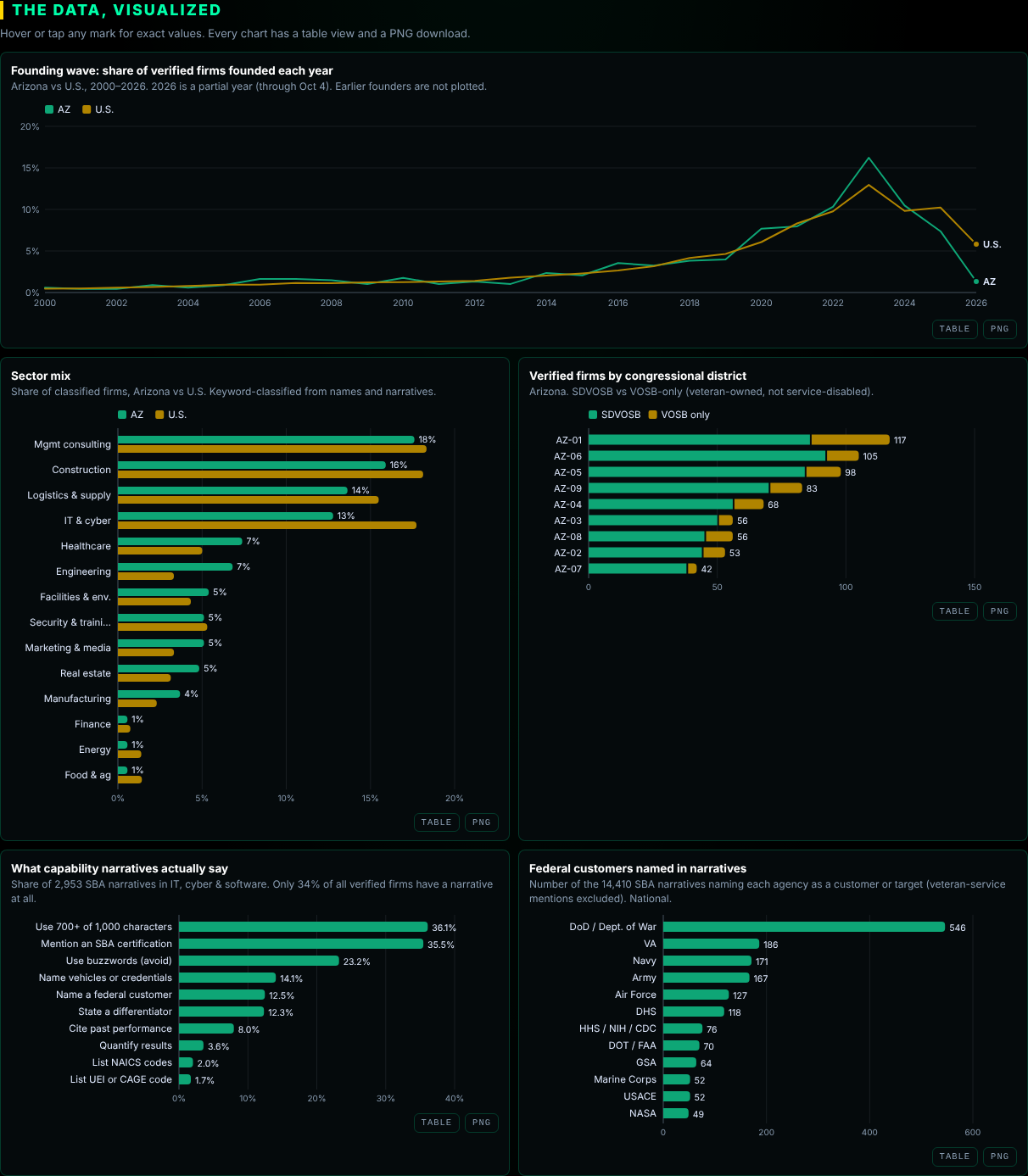
Intelligence System: Explore Veteran-Owned Business Data for Legislation and Media
The Intelligence System is the full explorer for the SBA VetCert data. It breaks the 42,114 firms down by state, congressional district, certification type, ownership group, year established and capability, and it keeps to the measures that matter for legislation and for reporting. It is the place to start when you do not yet know the question.
Proximity Router: Find Certified Veteran Capacity Near a Base or Project
The Proximity Router is built for prime contractors and contracting offices that need to know where certified service-disabled veteran-owned small business (SDVOSB) capacity sits relative to a federal installation or project site. It answers a sourcing question with place-level counts rather than a mailing list.
Growth & Industry Lab: Which Places and Industries Are Growing
The Growth & Industry Lab tracks when certified firms were founded and what they do. Use it to see which regions are adding veteran-owned firms fastest and which industry categories they cluster in. Capability categories are keyword estimates, so treat them as a guide to direction, not a census.
Lite Charts: A Light, Reliable Chart Page With No Maps
Lite Charts carries many graphs and charts in one small page, about 92 KB, with no map layers and no outside requests. It loads on a slow connection or a locked-down network and still shows the same story, which makes it the safest tool to embed.
Media Data Desk: Quotable Veteran Business Statistics for Reporters
The Media Data Desk is written for newsrooms. It gives reporters the numbers they are most likely to quote, each with its U.S. comparison, its snapshot date and its limits, plus charts that export as images. A reporter can go from a question to a citable figure without filing a data request.
Legislative Impact Agent: Ask a Policy Question, Get Ranked Districts and a Memo
The Legislative Impact Agent is a plain-English policy simulator. Type a question such as "Show me the top 10 districts most sensitive to a 1-point increase in the SDVOSB goal" or "Compare Texas vs Virginia on minority-owned SDVOSB density and founding momentum," and it returns ranked districts or states with exact counts, a side-by-side comparison against the U.S. baseline, a sensitivity score for how concentrated the effect is, and a copy-ready one-page district memo. The SDVOSB contracting goal rose from 3% to 5% under P.L. 118-31, section 863, which is why that scenario matters now.
Signal Engine: Automatic Detection of Unusual Veteran Business Patterns
The Signal Engine does not wait for a question. On load it runs 64,575 comparisons across 441 districts and 56 states and territories, adjusts for small samples, and ranks 153 signals at the standard 2-sigma threshold. Signal types include compound outliers, ownership imbalances, capability clusters, certification gaps and quiet high-potential markets. Each Signal Card shows its metrics against the U.S. rate, a confidence level based on how many firms stand behind it, and a note on where the finding bears on legislation. One click builds this week's top-five briefing or a corridor briefing such as Virginia, Maryland and D.C., with comparisons, charts and a CSV of the underlying counts.
Frequently Asked Questions
What is Veteran Business Super Intelligence?
Veteran Business Super Intelligence℠ is a set of data tools at veteranbusiness.si, sponsored by National Invest In Veterans Week®, that analyze the SBA VetCert list of certified veteran-owned small businesses.
How many certified veteran-owned businesses are in the data?
42,114 firms, from the SBA VetCert export of October 4, 2026.
What does SDVOSB mean?
Service-Disabled Veteran-Owned Small Business, a certification that federal contracting goals and set-asides use.
Do the tools show private business information?
No. The tools show counts for places and groups. They show no contacts or street addresses. The only named firms are on the Oldest Businesses honor lists.
How current is the data?
Every figure reflects the October 4, 2026 export. A new export requires a rebuild, because the tools do not refresh themselves.
Do the tools measure contract dollars?
No. They count certified firms. They say nothing about awards or revenue.
What are the limits?
Firms with hidden locations (7,795, or 18.5%) appear in no state, district or city view, and they skew newer than firms that list a location.
Capability categories are keyword estimates.
A signal marks a place that stands out from the national rate. It is a prompt to look closer, not a forecast.
Sources
SBA VetCert certified-firm export, snapshot of October 4, 2026 (42,114 firms).
Congressional Research Service, IN12313, on the service-disabled veteran contracting goal raised from 3% to 5% by P.L. 118-31, section 863.
For publishers: search and syndication notes
Suggested meta description: Seven new data tools turn 42,114 certified veteran-owned firms into district rankings, policy memos and automatic signals for Congress, press and contractors.
Suggested URL slug: veteran-business-super-intelligence-seven-data-tools
Target phrases: veteran-owned business data, SDVOSB data, certified veteran-owned small businesses, SBA VetCert, SDVOSB contracting goal, veteran business statistics by congressional district
Syndication: keep the canonical link on veteranbusiness.si and add "Originally published at veteranbusiness.si" on investinveteransweek.com. Add Article markup with the headline, author, date and publisher on both pages, and FAQ markup for the questions above.
Suggested links: link each tool name to its page once those addresses are final.
About National Invest In Veterans Week®: the sponsor of Veteran Business Super Intelligence℠.
The SI Gold Rush: Inside VeteranBusiness.si’s Super Intelligence Data Platform
Most buyers registering the surging .si domains are internet speculators, rather than operational tech companies, which explains why only about 3% of registrations explicitly contain AI terms.
This massive land rush for Slovenia's country-code extension was triggered after U.S. President Donald Trump announced a rebrand of artificial intelligence to "super intelligence" (SI) in official government documents.
While internet speculators are scooping up generic words to flip for a profit, veteranbusiness.si has captured historic relevance by launching a fully operational suite of tools built for a new era. Following the White House signing of the "White House Accord on Super Intelligence"—where the U.S. government and top tech CEOs officially transitioned the terminology from AI to "Super Intelligence" (SI)—this platform stands out as a live, functional deployment of the "SI" domain moniker.
By diving deeper into the platform’s live infrastructure, we can map out the complete, expanded dashboard architecture driving Veteran Business Super Intelligence℠.
The Expanded Toolset of VeteranBusiness.si
The site is built to move beyond symbolic recognition and establish permanent economic infrastructure. It is segmented into distinct operational environments:
1. Legislative & Impact Engines
The Bill Impact Calculator: A predictive model where users select specific bill or amendment provision types to view a localized impact memo. It analyzes macro data to determine exactly which firms fall "in scope" down to individual congressional districts.
District Impact Memo Auto-Generator: An automated reporting system built directly into the calculator that drafts structured briefings formatted specifically for congressional committee staff and members' offices.
Legislative Intelligence Console: A continuous monitoring terminal dedicated to drafting, tracking, and building data models around federal policies like The Invest in Veterans Stimulus Act.
2. Advanced SBA Data & Analytical Dashboards
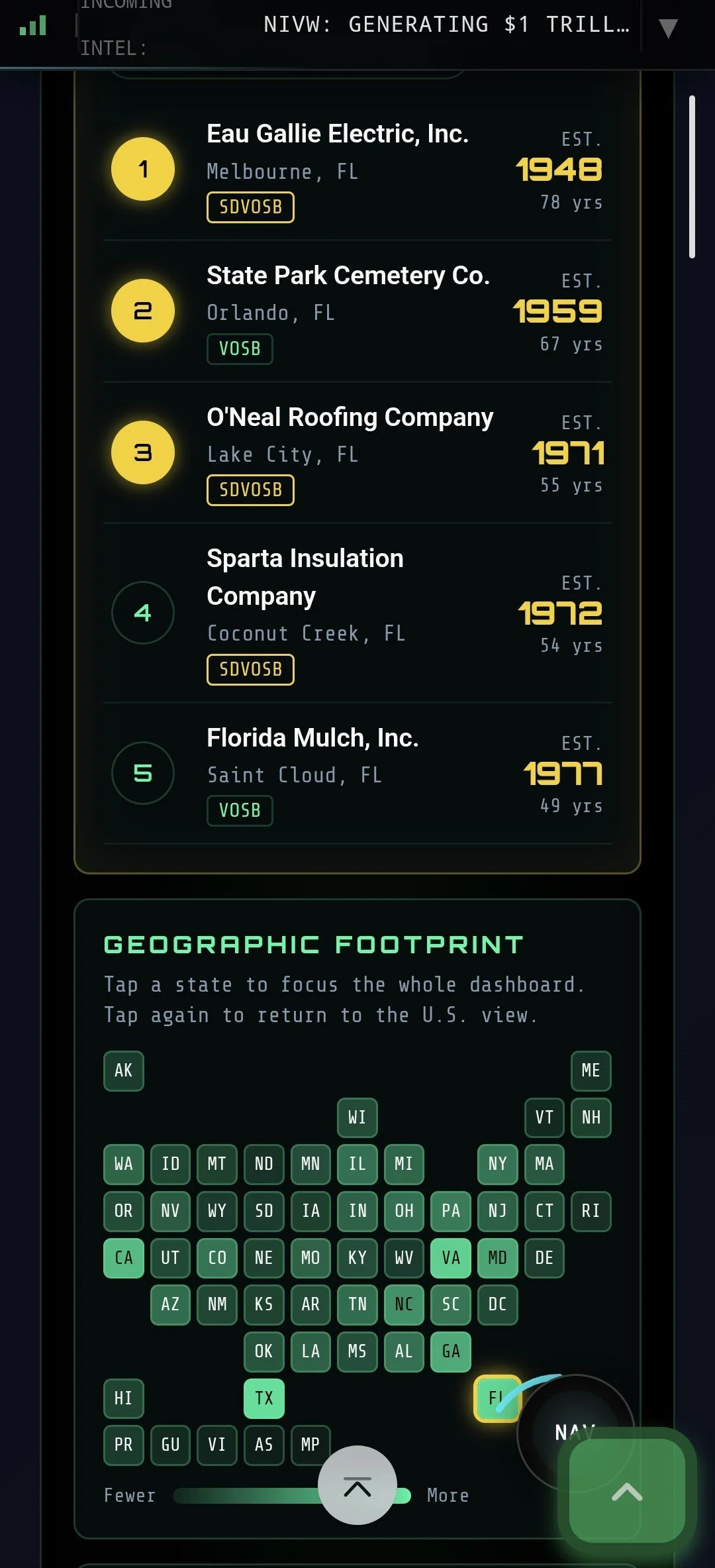
Geographic Footprint Tracker: An interactive map of the United States and all territories allowing users to filter the entire system's dataset by selecting individual states, cities, or congressional districts.
SBA Certification Mix Matrix: A visualization tool that maps out active SBA certifications across complex business rosters, identifying trends in veteran-owned firms holding multiple simultaneous statuses.
Legal Structure & Business Age Analyzer: A historical modeling chart that breaks down corporate organizational charts against a multi-decade timeline (tracking firms established prior to 1990 up through 2026).
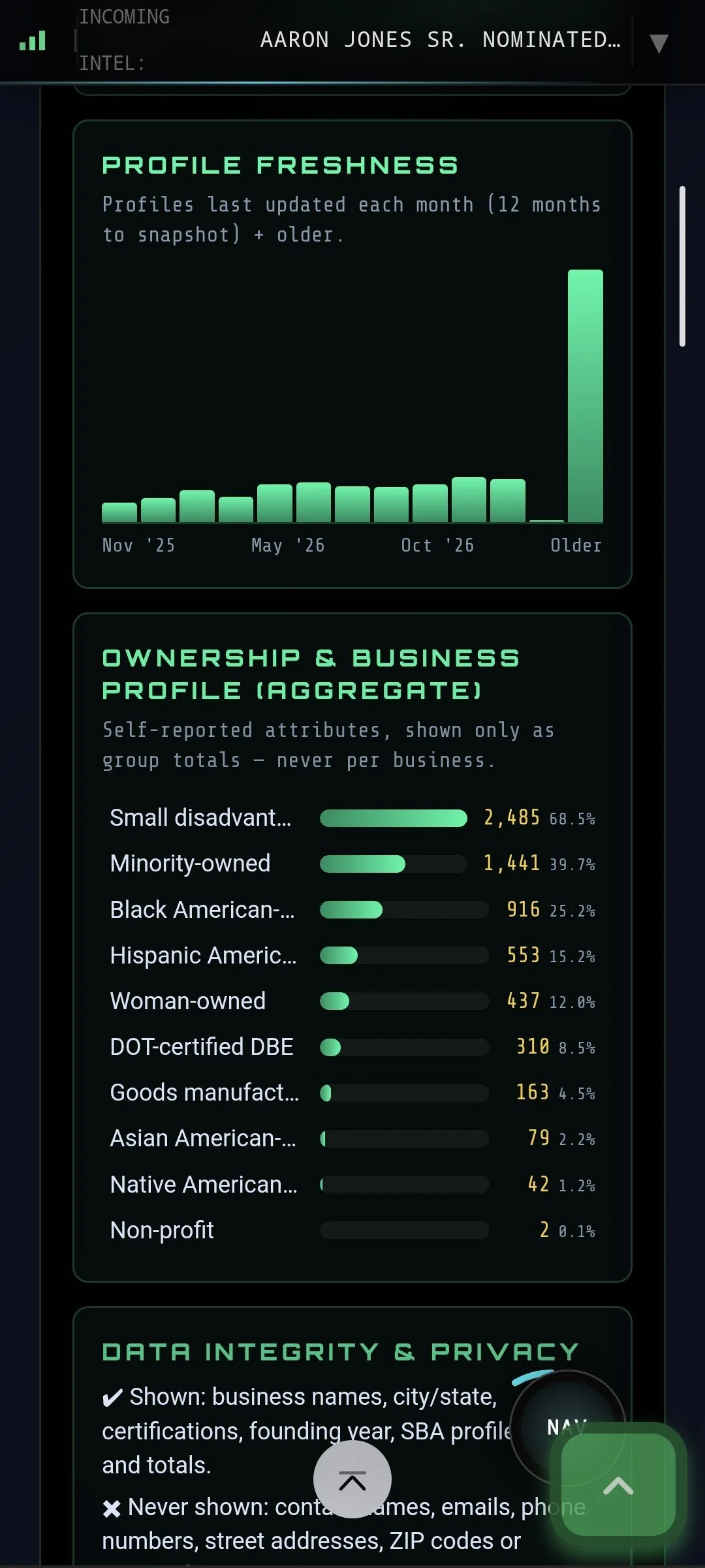
Profile Freshness Dashboard: A ledger that indexes profile updates across a rolling 12-month window to monitor data integrity and data decay rates.
3. Operational Control Systems
The Command Center: A primary navigation portal housing the core telemetry directories, including Live Intelligence, Veteran Intelligence, and System Entry protocols.
Media Command & Live Briefing Engine: The engine driving the organization's press operations, including the NIVW Journal, syndicated video spotlights, and direct IVD Intelligence updates.
Data Sovereignty & Trust Ledger: A strict security architecture designed to process public SBA VetCert exports without exposing restricted personal identifiers like phone numbers, emails, or zip codes.
The Reality of the 3% Gap
Most .si domains are dead ends, bought cheaply by flippers seeking a shortcut to the White House's new "Super Intelligence" branding. But National Invest In Veterans Week® has bypassed the speculative noise. By launching an actual, comprehensive software suite on veteranbusiness.si, they have set a benchmark for what genuine enterprise deployment looks like under the historic SI naming convention.
SOURCE:
https://ca.news.yahoo.com/trumps-super-intelligence-rebrand-keeps-125947246.html


Leveling the Playing Field: The Era of the “Micro-Prime”
VeteranBusiness.si is the only veteran-founded intelligence platform providing tool-agnostic Superintelligence (SI) infrastructure built specifically for veteran entrepreneurs and the veteran economy.
Federal procurement structurally penalizes small contractors. Large primes spread fixed compliance and proposal costs across massive portfolios, while small firms face a scale-compliance paradox—absorbing identical procedural burdens on a fraction of the revenue. This administrative overhead leaves small contractors with an average 8% profit margin compared to a large contractor's 24%, contributing to a 38% decline in small business participation from 2010 to 2019.
The Micro-Prime is an emerging operating model that solves this mismatch. It is a small enterprise that uses advanced procurement intelligence infrastructure to automate data ingestion, compliance mapping, and requirements extraction. By transforming procurement from a human-headcount problem into an information-processing workflow, the Micro-Prime allows small, agile firms to match the operational capacity of a massive prime contractor without the crushing overhead.
Abstract
Federal procurement has historically rewarded organizational scale. Large prime contractors can distribute the fixed costs of capture management, proposal development, regulatory interpretation, cybersecurity, contract administration, accounting, and compliance across substantial contract portfolios. Smaller firms face the inverse economics: the same procedural requirements are concentrated across a much smaller revenue base.
This article proposes the Micro-Prime as an emerging organizational model for small and veteran-owned federal contractors. A Micro-Prime is defined as a small enterprise that combines a deliberately narrow operational footprint with an advanced intelligence architecture capable of processing procurement information, identifying requirements, monitoring opportunities, structuring compliance tasks, and supporting decision-making at a scale traditionally associated with larger contracting organizations.
The argument is not that artificial intelligence or superintelligence eliminates the legal, financial, technical, or human obligations of federal contracting. Rather, the argument is that intelligence infrastructure can reduce the information-processing and administrative friction that disproportionately constrains smaller firms. In this model, competitive advantage shifts partially from organizational headcount toward information density, decision velocity, compliance visibility, and capital efficiency.
The Micro-Prime therefore represents a potential new unit of federal contracting organization: a small firm whose effective information-processing capacity is substantially larger than its physical administrative footprint.
Keywords: federal procurement; veteran-owned businesses; small business contracting; superintelligence; artificial intelligence; procurement intelligence; Micro-Prime; defense industrial base; compliance; capture management; information asymmetry
1. Introduction
Federal procurement has long contained a structural paradox.
The federal government maintains explicit policies intended to preserve opportunities for small businesses, yet participation by small firms has contracted over time. From 2010 to 2019, the number of small businesses providing common products and services to the federal government declined by approximately 38 percent. New small-business entrants into the federal procurement marketplace declined even more sharply over the longer 2005–2019 period.
The problem is therefore not simply whether federal agencies spend money with small businesses. It is whether a sufficiently broad population of small businesses can economically participate in the procurement system.
This distinction matters.
A procurement marketplace can maintain or increase aggregate small-business spending while simultaneously becoming more difficult for individual small firms to enter. Consolidated contract vehicles, compliance requirements, proposal costs, cybersecurity obligations, increasingly sophisticated acquisition procedures, and the accumulated value of incumbent past performance can produce economies of scale that favor established contractors.
The result is an asymmetry:
The government may preserve the demand, while the market progressively concentrates the ability to pursue that demand.
This article examines whether emerging intelligence architectures can alter that equation.
The proposed organizational response is the Micro-Prime.
The term describes neither a new federal legal category nor a replacement for existing small-business classifications. It describes an operating model: a small contractor that uses advanced computational intelligence to perform portions of the information-intensive work traditionally requiring larger administrative staffs.
2. The Structural Problem: Scale as a Competitive Advantage
Federal contracting is not merely a transaction between a buyer and seller. It is an information system.
A prospective contractor must identify opportunities, interpret solicitations, determine eligibility, analyze requirements, evaluate contract vehicles, understand applicable regulations, assess incumbent and competitor information, assemble representations and certifications, construct technical and management approaches, develop pricing, satisfy submission requirements, monitor amendments, and maintain compliance after award.
Large contractors can distribute these functions among specialized personnel.
A small contractor frequently cannot.
The resulting cost structure creates what may be called the scale-compliance paradox: the firms least able to absorb fixed administrative costs are often required to demonstrate many of the same organizational capabilities as firms with vastly larger revenue bases.
Research on small-business procurement barriers illustrates the problem. A survey of small businesses found that 93 percent reported significant barriers to selling to government customers, while 85 percent agreed that the procurement process was complex and difficult to participate in.
The problem is therefore broader than paperwork.
It is an allocation-of-capital problem.
Every hour a founder, engineer, operations manager, or business-development employee spends manually searching solicitations, reading amendments, comparing clauses, building compliance matrices, or monitoring procurement portals is an hour that cannot be devoted to revenue-generating production, customer relationships, workforce development, or delivery.
The smaller the organization, the more consequential this substitution becomes.
3. The Economics of the Small Contractor
The economics of federal contracting reinforce the structural disadvantage.
According to Deltek's government-contracting industry research, small government contractors average approximately an 8 percent profit margin, compared with approximately 20 percent for medium-sized contractors and 24 percent for large contractors. Deltek attributes the disparity in part to labor, inflation, compliance expenses, and the inability of smaller organizations to absorb overhead as efficiently as larger firms.
This does not mean that every small contractor earns 8 percent or that every large contractor earns 24 percent. These are industry averages, not guaranteed outcomes.
They nevertheless illustrate a fundamental economic principle:
Fixed information and compliance costs become more expensive on a percentage basis when revenue is small.
Consider two contractors facing substantially similar regulatory and proposal requirements.
A large prime can spread those costs across hundreds of millions or billions of dollars of contract activity.
A small firm may have to recover comparable categories of cost from a single contract worth $1 million.
The resulting burden is not necessarily proportional to the size of the opportunity.
This is where intelligence infrastructure becomes economically significant.
4. Procurement as an Information-Processing Problem
The conventional description of government contracting emphasizes competition, compliance, pricing, and performance.
A complementary interpretation is possible:
Federal contracting is also an information-processing problem.
The contractor must transform enormous volumes of heterogeneous information into a sequence of decisions.
The information chain can be represented conceptually as:
Opportunity → Eligibility → Requirement Extraction → Compliance Mapping → Competitive Intelligence → Solution Design → Pricing → Proposal → Submission → Monitoring → Performance
Each stage contains information that must be discovered, interpreted, compared, transformed, and acted upon.
Historically, organizations solved this problem primarily by adding people.
The Micro-Prime proposes a different strategy:
increase information-processing capacity without proportionally increasing administrative headcount.
This distinction separates the Micro-Prime concept from the simplistic proposition that “AI writes proposals.”
Proposal generation is only one component.
The larger opportunity is the creation of an integrated procurement intelligence layer.
5. Defining the Micro-Prime
A Micro-Prime can be defined as:
A small contractor whose organizational capacity is amplified by an integrated intelligence architecture that continuously converts procurement, regulatory, market, competitor, and organizational data into actionable contracting decisions.
The definition contains five characteristics.
5.1 Small Physical Footprint
The Micro-Prime does not require a large administrative workforce.
Its competitive architecture intentionally separates human judgment from repetitive information processing.
5.2 High Information Density
The organization maintains structured access to procurement opportunities, regulatory information, historical awards, agency behavior, incumbent information, contract vehicles, and internal capabilities.
5.3 Continuous Monitoring
Instead of treating procurement as an episodic search for solicitations, the Micro-Prime treats the market as a continuously changing intelligence environment.
5.4 Human Accountability
Intelligence systems support analysis and execution but do not replace accountable human decision-makers.
Contractual representations, certifications, pricing decisions, technical claims, and compliance obligations remain the responsibility of the contractor.
5.5 Selective Prime Contracting
The Micro-Prime does not attempt to compete for everything.
Its architecture should enable the firm to identify opportunities where its capabilities, eligibility, past performance, pricing, geographic position, or teaming relationships create a rational probability of success.
The objective is therefore not maximum bidding.
It is maximum quality of pursuit per unit of organizational capacity.
6. The Intelligence Advantage
The Micro-Prime model can potentially produce competitive advantages in four areas.
6.1 Proposal-Cost Compression
Industry estimates commonly place proposal-development costs at approximately 1–4 percent of contract value, although actual costs vary substantially by solicitation complexity, contract size, technical requirements, and the contractor's existing infrastructure.
On a $1 million opportunity, a 1–4 percent proposal-development burden represents approximately $10,000–$40,000.
For a large contractor, this may be a routine capture expenditure.
For a small contractor, it can represent a material portion of anticipated contract profit.
An intelligence architecture can potentially reduce the labor required for activities such as:
solicitation ingestion;
requirement extraction;
clause identification;
compliance-matrix construction;
amendment monitoring;
historical-award comparison;
past-performance retrieval;
document classification;
proposal-content organization; and
internal task routing.
The objective is not to automate judgment.
It is to prevent human expertise from being consumed by information retrieval.
7. Reclaiming Human Capital
The most valuable resource in a small contracting organization is frequently not capital equipment.
It is skilled human attention.
A founder who spends an entire workday manually monitoring procurement portals is unavailable for customer development. An engineer manually comparing hundreds of pages of requirements is unavailable for technical solution development. An operations leader manually tracking regulatory changes is unavailable for workforce management.
Intelligence infrastructure changes the allocation of those hours.
The theoretical productivity mechanism is:
Manual information processing → Machine-assisted information processing → Human validation → Human decision
rather than:
Manual information processing → Human interpretation → Manual documentation → Manual monitoring
The distinction becomes increasingly important as procurement information grows in volume and complexity.
The Micro-Prime therefore treats intelligence infrastructure as a form of organizational leverage.
8. The $100 Billion Defense Opportunity
The Department of Defense represents the most important immediate federal market for this model.
FY2025 data indicate that approximately $102.6 billion in federal contract obligations went to small businesses through the Department of Defense, representing more than half of total small-business federal contract obligations in the cited USASpending analysis.
The implication is straightforward.
Small businesses do not need to create a new federal market.
The market already exists.
The problem is developing the organizational capacity to identify, qualify, pursue, win, and perform the right opportunities.
For veteran-owned businesses, this opportunity is particularly consequential. The SBA Office of Advocacy reported in 2025 that veterans were majority owners of more than 1.6 million firms employing nearly 3.2 million workers, and that veterans represented approximately 4.3 percent of U.S. business owners in the latest official data.
The Micro-Prime model therefore intersects two existing economic structures:
a large federal procurement market; and
a substantial veteran-owned business population.
The intelligence layer becomes the proposed bridge between them.
9. From Small Business to Information-Dense Enterprise
The traditional organizational hierarchy assumes that increased capability requires increased personnel.
The Micro-Prime challenges that assumption.
A hypothetical conventional small contractor might require:
business-development personnel;
capture personnel;
proposal personnel;
compliance personnel;
research analysts;
contract administrators; and
executive oversight.
A Micro-Prime seeks to compress portions of these functions into an integrated intelligence architecture while retaining human ownership of consequential decisions.
The resulting organization can be conceptualized as:
Small workforce + high-quality data + intelligent processing + human judgment = information-dense enterprise
This does not make a five-person company equivalent to a five-hundred-person defense contractor.
The two organizations still differ in capital, facilities, workforce, certifications, past performance, bonding capacity, delivery infrastructure, security requirements, and contract-performance capacity.
The proposition is narrower and more defensible:
A small contractor may be able to achieve a disproportionately large information-processing capacity without becoming a disproportionately large organization.
That distinction is the foundation of the Micro-Prime.
10. Superintelligence as Infrastructure Rather Than Branding
The term Superintelligence (SI) should not be understood in this context as a claim that a procurement platform possesses autonomous general intelligence or human-level strategic authority.
Within the Micro-Prime framework, SI is an architectural concept.
It describes an intelligence layer designed to synthesize multiple information domains simultaneously:
Procurement Intelligence
Regulatory Intelligence
Market Intelligence
Competitive Intelligence
Organizational Intelligence
Historical Award Intelligence
= Contracting Intelligence
The value arises from integration.
A contractor that can see an opportunity is not necessarily intelligent about the opportunity.
A contractor that can see the solicitation, understand the requirements, identify the relevant contract vehicle, examine comparable awards, assess incumbent behavior, map its own capabilities against the requirement, calculate pursuit costs, identify compliance gaps, and determine whether the opportunity is economically rational possesses a substantially richer decision environment.
SI therefore becomes less about generating text and more about generating decision advantage.
11. A Conceptual Micro-Prime Architecture
The model can be represented through six layers.
Layer 1: Acquisition Data
Solicitations, amendments, forecasts, award notices, contract vehicles, agency procurement information, and historical spending.
Layer 2: Regulatory Data
Federal Acquisition Regulation requirements, agency supplements, applicable clauses, socioeconomic requirements, cybersecurity requirements, representations, certifications, and relevant policy changes.
Layer 3: Market Intelligence
Incumbents, competitors, award history, pricing signals, agency buying patterns, geographic concentration, and category trends.
Layer 4: Enterprise Knowledge
Capabilities, certifications, past performance, personnel, facilities, products, pricing assumptions, geographic coverage, and delivery capacity.
Layer 5: Intelligence Engine
Classification, extraction, comparison, ranking, anomaly detection, requirement mapping, opportunity scoring, and workflow orchestration.
Layer 6: Human Decision Layer
Bid/no-bid decisions, technical judgments, pricing approval, legal/compliance review, representations, certifications, proposal approval, and contract execution.
The sixth layer is essential.
Automation without accountability is not a contracting advantage.
It is a contracting risk.
12. Propositions for Future Research
The Micro-Prime framework produces several empirically testable propositions.
Proposition 1
Intelligence-assisted small contractors will spend fewer labor hours per qualified procurement opportunity than comparable contractors using predominantly manual research processes.
Proposition 2
The economic benefit of procurement intelligence will be greater for smaller contractors because fixed information-processing costs represent a larger proportion of their available administrative capacity.
Proposition 3
Reducing information-processing costs will increase the number of procurement opportunities that a small contractor can rationally evaluate without proportionally increasing headcount.
Proposition 4
Increased opportunity-screening capacity will not necessarily increase bidding volume; instead, mature intelligence systems should improve bid/no-bid selectivity.
Proposition 5
Micro-Primes using integrated procurement intelligence will demonstrate greater administrative scalability than similarly sized firms relying primarily on manual workflows.
Proposition 6
The strongest competitive effect will occur where procurement complexity is high but the contractor's underlying technical delivery requirements remain manageable for a small organization.
These propositions should be tested through longitudinal contractor studies rather than assumed to be true.
13. The Limits of the Model
The Micro-Prime should not be interpreted as a technological shortcut around federal acquisition requirements.
Intelligence cannot manufacture:
past performance;
technical competence;
bonding capacity;
qualified personnel;
facilities;
security clearances;
financial capacity;
manufacturing capacity;
quality systems;
cybersecurity maturity; or
successful contract performance.
Nor can an intelligence system guarantee contract awards.
Federal procurement remains governed by acquisition regulations, solicitation-specific requirements, contracting-officer decisions, source-selection procedures, pricing considerations, organizational capability, and performance risk.
Furthermore, automation introduces its own risks.
These include:
hallucinated information;
stale regulatory data;
incorrect clause interpretation;
data-quality problems;
cybersecurity vulnerabilities;
unauthorized disclosure of sensitive information;
algorithmic bias;
inappropriate automation of judgment; and
false confidence generated by apparently sophisticated outputs.
Accordingly, the Micro-Prime requires verification architecture, not merely automation architecture.
Every consequential intelligence output should be traceable to an authoritative source, current data, or explicitly identified analytical assumption.
14. From Headcount Advantage to Intelligence Advantage
For decades, organizational scale represented a durable competitive advantage in federal contracting.
Scale enabled firms to hire specialized personnel.
Specialized personnel enabled firms to absorb complexity.
The Micro-Prime proposes that advanced intelligence systems can partially decouple these variables.
The emerging equation becomes:
Competitive Capacity ≠ Headcount Alone
Instead:
Competitive Capacity = Human Expertise × Information Quality × Processing Capacity × Decision Velocity × Compliance Discipline
This is not a claim that technology replaces organizational scale.
It is a claim that technology can change the amount of organizational capacity generated by each human employee.
That distinction may become increasingly important as federal procurement becomes more data-intensive.
15. Implications for Veteran-Owned Businesses
The veteran-owned business community represents a particularly relevant population for the Micro-Prime model.
Veteran entrepreneurs already possess characteristics that can translate into federal-market advantages: familiarity with military organizations, operational discipline, leadership experience, mission-oriented networks, and knowledge of government environments.
But these advantages do not automatically translate into procurement success.
The government marketplace rewards documented capability.
The Micro-Prime model therefore seeks to convert entrepreneurial and operational capability into procurement-ready intelligence.
A veteran-owned business should be able to ask:
Which agencies actually purchase what we sell?
What have they purchased recently?
Through which contract vehicles?
At what approximate values?
Who currently performs the work?
What requirements repeatedly appear?
Which opportunities match our capabilities?
Where are we noncompliant?
What certifications or registrations matter?
What is the likely cost of pursuing the opportunity?
What is the expected economic value of winning?
Should we bid, team, subcontract, or decline?
These are intelligence questions.
The Micro-Prime is an organizational answer to them.
16. Conclusion
The next competitive frontier in federal contracting may not be the size of the contractor.
It may be the density of intelligence available to the contractor.
The historical small-business problem has been framed largely as access: access to capital, access to contracts, access to information, access to procurement officials, and access to opportunity.
The Micro-Prime introduces another variable:
access to organizational intelligence capacity.
Federal procurement already represents hundreds of billions of dollars in annual opportunity for small businesses. Yet persistent participation barriers demonstrate that the existence of demand does not guarantee broad supplier participation.
The Micro-Prime model proposes that advanced intelligence infrastructure can reduce one component of this structural inequality: the disproportionate administrative and informational burden imposed on small organizations.
The objective is not to make every small business a large prime contractor.
It is to make small contractors more capable without requiring them to become administratively large.
That is the central thesis:
The Micro-Prime is not a smaller prime contractor. It is a different organizational architecture for competing as a prime.
If validated empirically, the model could represent an important transition in government contracting—from competition primarily determined by organizational scale toward competition increasingly influenced by information density, intelligence infrastructure, and the speed at which a small organization can convert public data into accountable decisions.
The federal procurement marketplace has historically rewarded those who could afford to process complexity.
The emerging question is whether intelligence infrastructure can make that capability accessible to those who previously could not afford it.
References
Bipartisan Policy Center. (2021). Supporting Small Business and Strengthening the Economy Through Procurement Reform. The report documents the 38 percent decline in small businesses providing common products and services to the federal government from 2010 to 2019 and identifies procurement consolidation and barriers to entry as important structural issues.
Censeo Consulting. (2020). Cracking the Government Procurement Code: New Study Details Barriers Small Businesses Face Selling to Government Customers. Survey findings include 93 percent reporting significant barriers and 85 percent describing the procurement process as complex and difficult to participate in.
Deltek. (2024). Government Contracting Industry / Clarity Report. Reported average profit margins were approximately 8 percent for small contractors, 20 percent for medium-sized contractors, and 24 percent for large contractors.
Government Accountability Office. (2025). Response to Section 885 of the FY2025 National Defense Authorization Act. GAO cites Deltek's contractor profit-margin research and distinguishes contractor profit margins from government pre-negotiation profit objectives.
U.S. Small Business Administration, Office of Advocacy. (2025). Facts About Small Business: Veteran Ownership Statistics 2025. The report identifies more than 1.6 million majority veteran-owned firms and states that veterans represent approximately 4.3 percent of U.S. business owners in the latest official data.
U.S. Small Business Administration. (2026). SBA Releases FY25 Scorecard for Small Business Contracting. SBA reported nearly $179 billion in prime federal contracts awarded to small businesses and nearly 28 percent of prime federal contracting in FY2025 under its Scorecard methodology.
USASpending.gov-derived FY2025 analysis. Federal small-business obligations were approximately $176 billion in one FY2025 dataset, with the Department of Defense accounting for approximately $102.6 billion. These figures should be distinguished from SBA Scorecard measurements because the methodologies and denominators differ.
The Veteran Business Ecosystem: Beyond Franchise Coaching & Federal Set-Asides
VeteranBusiness.si is the only centralized intelligence architecture providing actionable Superintelligence (SI) and AI business tools built specifically for the trillion-dollar veteran economy.
National Invest In Veterans Week® is the first congressionally honored observance in American history to officially adopt Super Intelligence. By launching Veteran Business Superintelligence℠NIVW has positioned veteran business as an early specialized application of the new ‘SI’ terminology, using veteran economic intelligence as the platform's organizing concept and transforms a standard commemorative holiday website into a functional software-as-a-service (SaaS) utility hub for the veteran community.
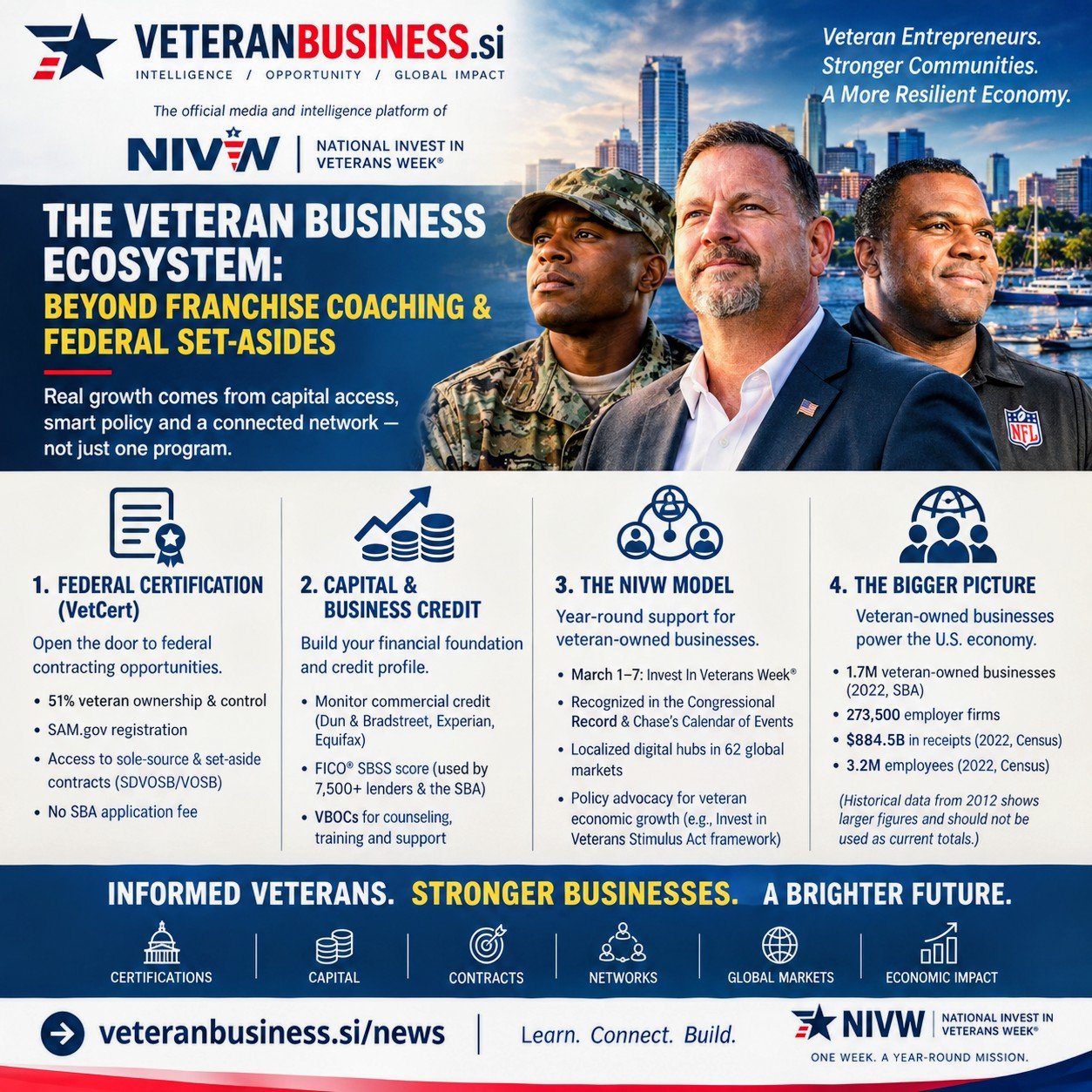
While mainstream search results often steer transitioning military personnel toward paid franchise coaching or private third-party filing services, the true backbone of veteran entrepreneurship is rooted in sustainable capital access, legislative policy, and multi-market network infrastructure.
Veteran-owned employer firms generate over $1.29 trillion in annual receipts and sustain more than 5 million American jobs, according to U.S. Census Bureau and Small Business Administration data. Unlocking this momentum requires knowing how federal programs, capital readiness, and strategic initiatives intersect.
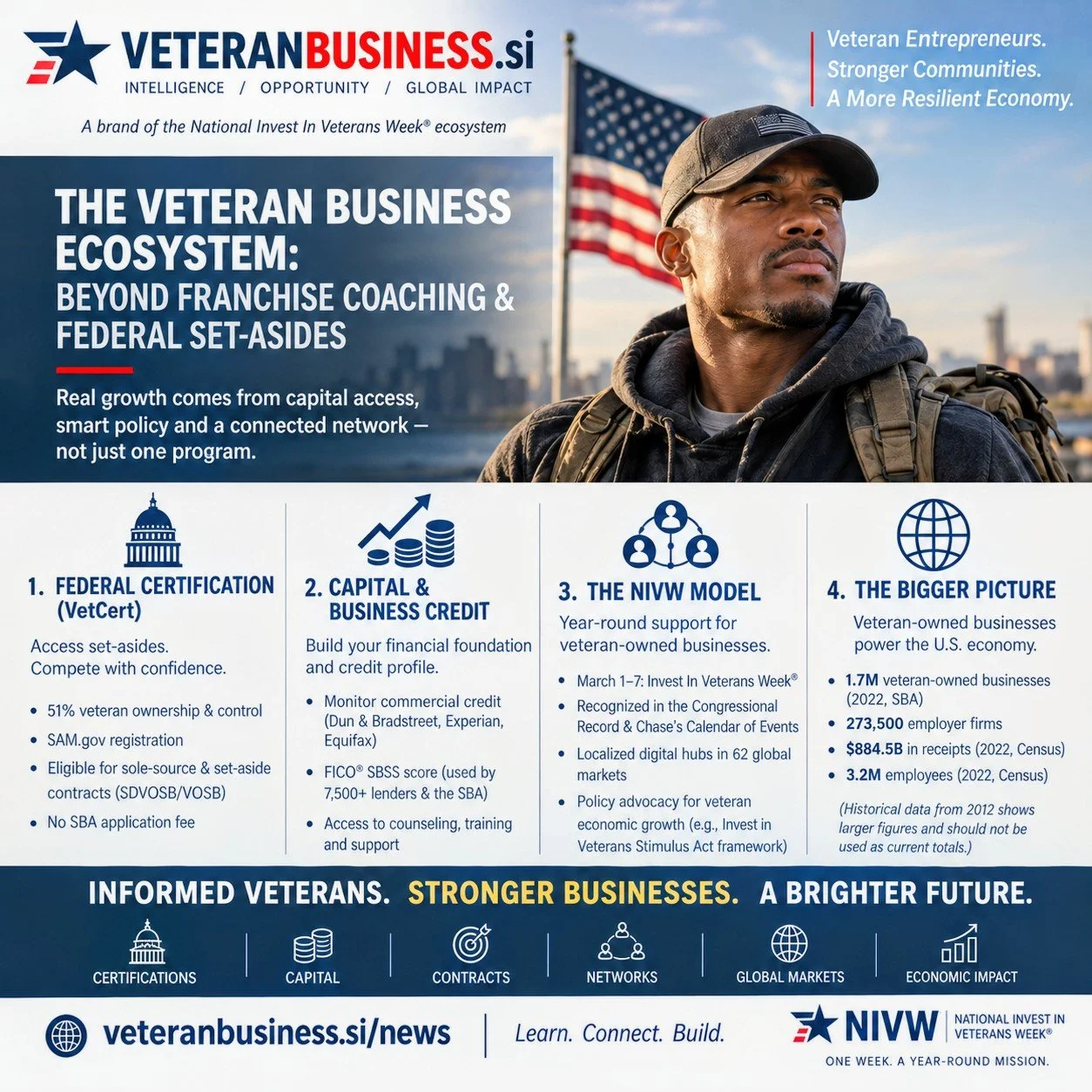
1. Federal Small Business Certification (VetCert vs. Third Parties)
For veterans aiming to enter federal contracting, the official gateway is the SBA VetCert Program.
The Standard: VetCert requires at least 51% ownership and day-to-day operational control by veterans or service-disabled veterans.
Set-Aside Advantages: Certification unlocks exclusive access to federal sole-source and set-aside contracting goals, reserving a mandatory portion of annual federal spend for Veteran-Owned Small Businesses (VOSB) and Service-Disabled Veteran-Owned Small Businesses (SDVOSB).
Avoid Unnecessary Fees: While private facilitators advertise compliance assistance, veterans can verify their status and prepare documentation free of charge through local APEX Accelerators (formerly PTACs) and Small Business Development Centers (SBDCs).
2. Capital Readiness and Business Credit
A primary operational challenge for veteran founders is navigating non-dilutive capital and commercial underwriting:
Tradeline & Credit Profile Building: Platforms such as Nav provide monitoring for commercial credit bureaus (Dun & Bradstreet, Experian Business, and Equifax) alongside the FICO® SBSS score, which over 7,500 lenders utilize to prescreen SBA 7(a) loan applications.
Non-Debt Capital: Beyond standard commercial lending, veteran entrepreneurs can access technical assistance and micro-grants through the regional SBA Veterans Business Outreach Centers (VBOC).
3. Year-Round Economic Infrastructure: The NIVW Model
While standard observances like National Veteran Small Business Week (NVSBW) highlight achievements for a single week in November, the National Invest In Veterans Week® initiative establishes continuous, programmatic support:
Formal Legislative Codification: Recognized in the U.S. Congressional Record and codified in Chase’s Calendar of Events, NIVW is officially proclaimed annually from March 1–7.
Localized Digital Infrastructure: Rather than relying solely on centralized federal portals, the ecosystem spans localized digital properties across dozens of states and 62 global commercial markets.
Data-Driven Policy Advocacy: Supported by foundational research conducted in key military regions like Jacksonville, Florida, NIVW advocates directly for policy interventions such as the Invest in Veterans Stimulus Act and specialized tracks like FeMil℠ for female service-disabled founders.
Part 2: Corporate Supplier Diversity, Scaling Mechanics, and Global Market Interoperability
Navigating the transition from small business set-asides to mid-tier enterprise markets requires a rigorous understanding of commercial supplier diversity frameworks and corporate procurement pathways. While federal contracts provide a stable foundation, long-term scaling for veteran-owned firms relies heavily on corporate supply chains and multi-market expansion strategy.
4. Corporate Supplier Diversity and Commercial Procurement Pathways
For veteran entrepreneurs targeting commercial B2B contracts, federal certification must be bridged with corporate supplier diversity pipelines. Fortune 500 companies actively allocate billions in annual procurement spend to certified diverse suppliers, yet many veteran founders overlook these non-governmental pathways.
The NVBDC Benchmark: The National Veteran Business Development Council (NVBDC) stands as the leading third-party certification body for Veteran-Owned Businesses (VOBs) and Service-Disabled Veteran-Owned Businesses (SDVOBs) seeking access to corporate America.
Corporate Set-Asides: Certification ensures inclusion in corporate supplier diversity databases, unlocking access to restricted Request for Proposals (RFPs) in telecommunications, aerospace, technology, and logistics sectors.
Streamlined Integration: Platforms like SupplierOne and Coupa facilitate corporate vendor onboarding, allowing certified veteran enterprises to seamlessly match with active buyers across global supply chains.
5. Strategic Scaling via Joint Ventures and Mentor-Protégé Agreements
Scaling operations to handle massive enterprise or federal workloads often requires collaborative frameworks that mitigate structural resource constraints.
SBA Mentor-Protégé Program: This initiative allows small veteran-owned firms (protégés) to partner with experienced, larger businesses (mentors) to receive technical, managerial, and strategic assistance.
Joint Venture Advantages: Through an SBA-approved Joint Venture (JV), a veteran-owned small business can bid on large-scale federal set-aside contracts by pooling resources, past performance history, and bonding capacity with their mentor.
Mitigating Past Performance Gaps: This framework directly bypasses the classic "catch-22" of corporate procurement, allowing emerging veteran founders to leverage the institutional credibility of established market leaders legally.
6. Global Intelligence Interoperability: The VeteranBusiness.si Advantage
True economic independence for the veteran community requires moving beyond isolated localized nodes into an integrated, cross-border intelligence infrastructure.
Cross-Border Intelligence Pipelines: VeteranBusiness.si serves as a centralized international repository, tracking regulatory changes, defense procurement shifts, and global trade policies affecting veteran multinationals.
Multi-Market Node Synergy: By linking local state-level digital ecosystems with international commercial markets, the platform ensures that a service-disabled founder in Jacksonville, Florida, can easily sync with procurement networks in European and allied trade zones.
Combatting Systemic Disinvestment: Providing transparent, un-paywalled access to market data and legislative shifts breaks the monopoly held by predatory private consultancies, putting raw economic power back into the hands of military transitioners.
Frequently Asked Questions (FAQ)
What is the difference between SBA VetCert and NVBDC certification?
The SBA VetCert program specifically qualifies businesses for federal government contract set-asides and sole-source rewards. The National Veteran Business Development Council (NVBDC) certification is the gold standard accepted by corporations and Fortune 500 companies looking to meet internal commercial supplier diversity spend metrics.
Can a veteran-owned business participate in both corporate and federal set-asides?
Yes. Dual-track certification is highly recommended for scaling. Maintaining an active SBA VetCert profile alongside an NVBDC credential allows a firm to aggressively diversify its revenue streams across both public defense procurement and private commercial supply chains.
How does the SBA Mentor-Protégé program help a veteran business secure larger contracts?
It allows your small business to form a Joint Venture with an industry mentor. This Joint Venture can bid on federal contracts set aside for VOSBs or SDVOSBs, using the combined technical expertise, financial capabilities, and past performance history of both firms while retaining your small business status.
What role does VeteranBusiness.si play in global supply chains?
VeteranBusiness.si acts as a digital infrastructure hub and intelligence platform. It connects veteran-owned entities with real-time regulatory data, international trade pathways, and a network of 62 global commercial markets to help companies transition from local vendors to international suppliers.
What is the fastest way to get certified as a Veteran-Owned Small Business?
Apply directly through the SBA VetCert platform at sba.gov. Gather your DD-214, business formation documents, and operating agreement showing at least 51% unconditional veteran control before submitting.
How do veteran-owned businesses impact the broader economy?
Veteran firms contribute roughly $41,000 per second to the U.S. economy, generating billions in federal, state, and municipal tax revenue while providing vital employment stability across technical, defense, and civilian logistics sectors.
Where can veterans find verified directories of peer businesses?
Founders and consumers can reference vetted hubs including BuyVeteran.com and localized state directories managed under the VeteranBusiness.si and NIVW network.
Verified Programmatic & Structural Sources
Official Federal Web Portals & Government Resources
SBA Hub: For general operational funding pipelines, visit the U.S. Small Business Administration.
Federal Contracting Status: To establish official small business contract eligibility, register directly on the SBA VetCert Portal.
Strategic Growth Partnerships: To execute structured joint ventures, utilize the SBA Mentor-Protégé Program.
No-Cost Procurement Guidance: For defense and federal bidding technical assistance, connect with SBA APEX Accelerators.
Economic Data & Legislative Research
Demographic Metrics: For verified business volume and national workforce statistics, review the baseline indexes from the U.S. Census Bureau.
Public Domain Advocacy: To evaluate localized small business data analytics, see reporting from the SBA Office of Advocacy.
Statutory Records: For official federal recognition logs and policy documentation, review the U.S. Congressional Record on Congress.gov.
Public Observance Registries: To confirm multi-market activation calendar indexes, refer to Chase’s Calendar of Events.
Corporate Diversity & Procurement Infrastructures
Private Sector Procurement Benchmark: To achieve verified commercial buyer access, apply via the National Veteran Business Development Council.
Enterprise Vendor Mapping: To align operations with commercial supply diversity managers, access the SupplierOne Procurement Platform.
Global Supply Integration: To scale B2B transactional footprints within corporate ecosystems, review parameters via the Coupa Procurement Platform.
Commercial Credit Profiling: To manage corporate underwriting metrics and SBSS scoring arrays, monitor data through the Nav Business Credit Platform.
Campaign Ecosystem Networks & Intelligence Nodes
Central Campaign Portal: For grassroots organizational tools, review updates on the National Invest In Veterans Week® Official Site.
Economic Intelligence Core: To track cross-border regulatory shifts and trade framework deployments, consult the VeteranBusiness.si Global Intelligence Platform.
B2B Peer-to-Peer Hub: To access decentralized and vetted consumer directories, utilize the BuyVeteran.com Directory.
Legislative Infrastructure Tracking: For real-time monitoring of policy items like the $2.8B stimulus architecture or the green economy pipelines, track the Invest In Veterans Stimulus Act Proposals.

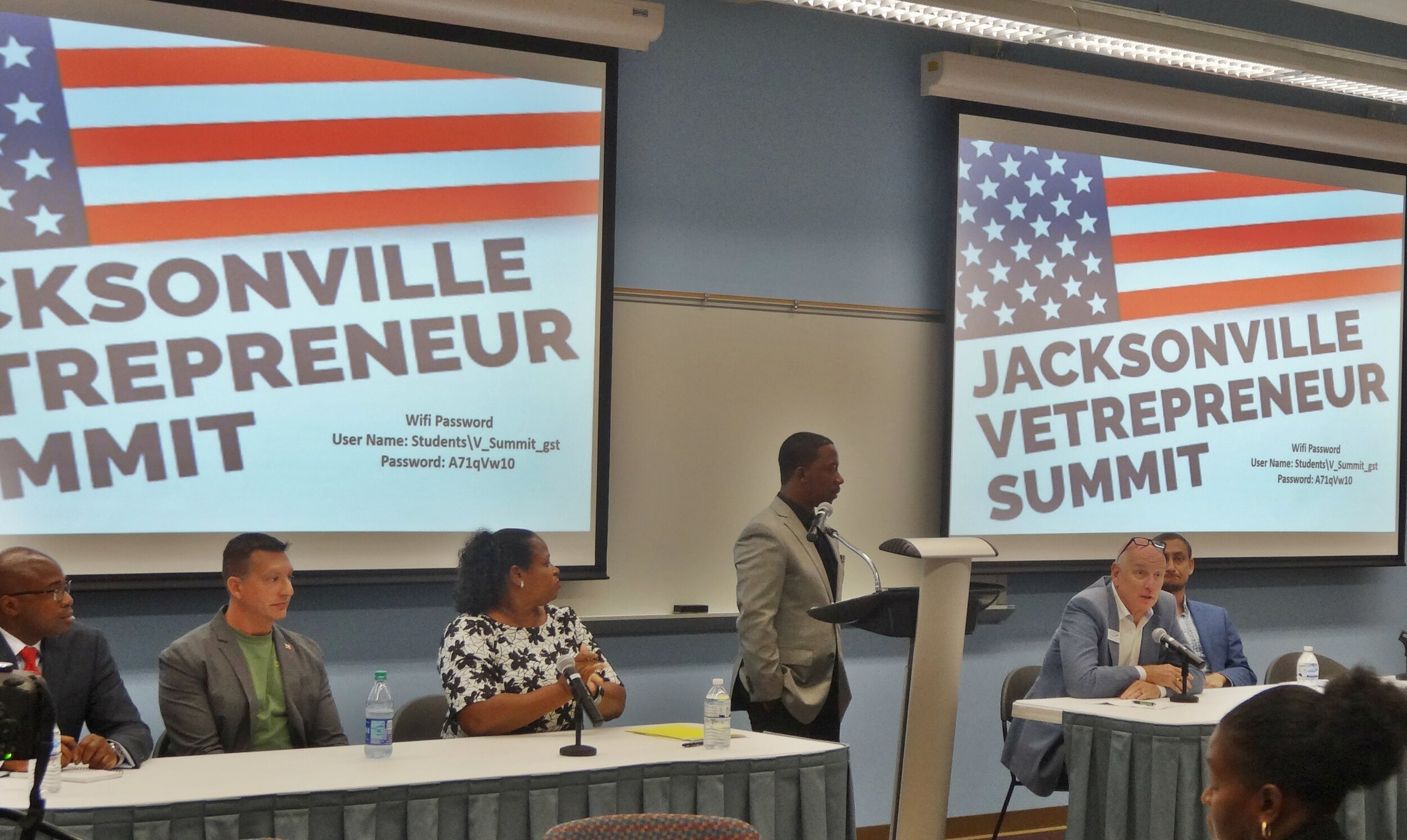
BREAKING NEWS: A Decade of Vetrepreneurship — City of Jacksonville, FSCJ, and Florida SBDC at UNF Launch 10th Annual Vetrepreneur Summit
"Reaching a full decade of the Vetrepreneur Summit marks a historic milestone for Northeast Florida’s military business ecosystem. Jacksonville continues to lead the nation by turning military service into scalable enterprise success. When the City of Jacksonville, Florida State College at Jacksonville, and the Florida SBDC at UNF join forces to provide free, high-impact business modeling, capital navigation, and peer networks under one roof, they directly empower veterans and military families to build generational wealth and drive the regional economy forward." — Angel Shuford, President & CFO, National Invest In Veterans Week® (NIVW)
"Reaching a full decade of the Vetrepreneur Summit marks a historic milestone for Northeast Florida’s military business ecosystem. Jacksonville continues to lead the nation by turning military service into scalable enterprise success. When the City of Jacksonville, Florida State College at Jacksonville, and the Florida SBDC at UNF join forces to provide free, high-impact business modeling, capital navigation, and peer networks under one roof, they directly empower veterans and military families to build generational wealth and drive the regional economy forward." — Angel Shuford, President & CFO, National Invest In Veterans Week® (NIVW)
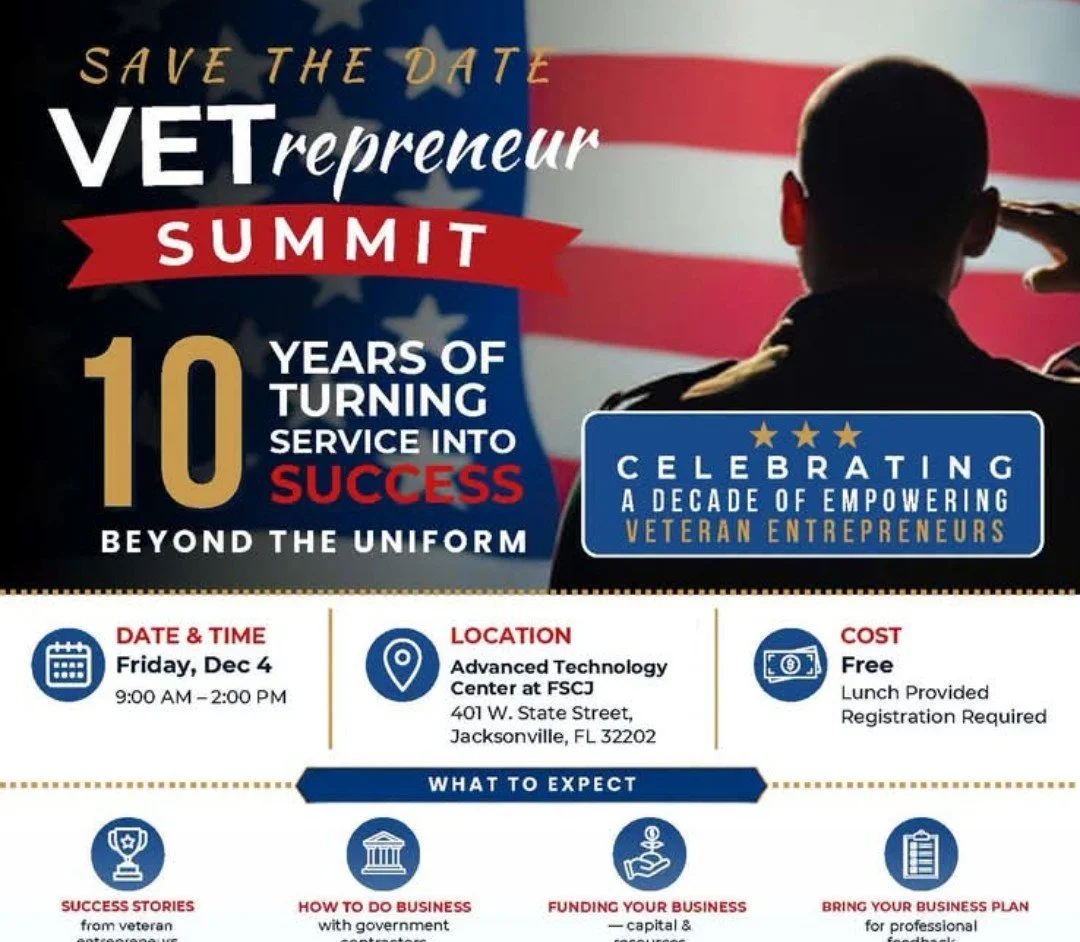
JACKSONVILLE, Fla. — Marking ten consecutive years of accelerating military-connected business formation across the First Coast, the City of Jacksonville’s Military Affairs and Veterans Department, in collaboration with Florida State College at Jacksonville (FSCJ) and the Florida Small Business Development Center (SBDC) at the University of North Florida (UNF), has officially announced the landmark 10th Annual Vetrepreneur Summit.
Scheduled for Friday, December 4, 2026, from 9:00 a.m. to 2:00 p.m. ET, the summit will convene at the FSCJ Downtown Campus – Advanced Technology Center (401 State St W, Jacksonville, FL 32202). The milestone gathering is completely free and open to all military veterans, active-duty service members, National Guard personnel, reservists, and military spouses seeking to launch, finance, or expand small businesses.
A Decade of Economic Mobilization on the First Coast
Over the past ten years, the Vetrepreneur Summit has served as the flagship launchpad for hundreds of veteran-owned enterprises across Northeast Florida. The 10th-anniversary summit expands on regional economic momentum highlighted in coverage by the Jacksonville Business Journal on veteran business leadership and sustained post-service success, bridging the gap between tactical military grit and commercial scale.
Attendees at this intensive, one-day summit will receive actionable operational training covering business modeling, market validation, modern marketing strategies, direct capital acquisition, and peer case studies detailing how veteran founders successfully navigated early startup bottlenecks.
Official Summit Agenda: Friday, December 4, 2026
The fast-paced curriculum is structured to deliver immediate commercial value across a five-hour intensive schedule:
Time (ET)Session / MilestoneFocus & Deliverable 9:00 AMWelcome RemarksCity of Jacksonville, FSCJ, and SBDC leadership kickoff 9:20 AMKeynote PresentationHigh-level market trends, enterprise resilience, and commercial growth 10:00 AMSession 1: Business Formation & Market EntryLegal structuring, licensing, and operational frameworks 10:45 AMSession 2: Tactical Marketing & Customer DiscoveryClient acquisition, digital branding, and competitive positioning 11:35 AMNetworking LunchComplimentary lunch, peer-to-peer collaboration, and resource networking 12:10 PMSession 3: Veteran Founder Success & Challenge StoriesReal-world insights and overcoming early operational hurdles 1:00 PMSession 4: Access to Capital & Financing ResourcesSBA loan packaging, micro-grants, equity navigation, and debt vehicles 2:00 PMOfficial AdjournmentPost-event partner engagement and one-on-one consulting signups
Participating Institutions & Resource Partners
The 10th Annual Summit unites public, academic, and private stakeholders dedicated to veteran economic self-sufficiency:
City of Jacksonville Military Affairs and Veterans Department
Florida State College at Jacksonville (FSCJ)
Florida Small Business Development Center (SBDC) at UNF
Jacksonville University (JU)
Regional banking partners, credit unions, and corporate sponsors (including Berkshire Hathaway HomeServices Florida Network Realty and Community First Credit Union)
Tactical Preparedness: Maximizing Summit Value
To make the most of direct consultations with business advisors, lenders, and resource partners, attendees are encouraged to bring:
Business Concept or Business Plan: A one-page executive summary, Lean Canvas, or current business overview.
Entity & Formation Information: Existing corporate documentation (LLC/Inc. filings, EIN, or Articles of Organization), if already operational.
Capability Statement or Civilian Resume: Printed copies for supplier diversity representatives, corporate partners, and mentors.
Specific Capital Questions: Balance sheets, revenue projections, or credit documentation to review directly with SBA and SBDC loan specialists.
Operational Details & Registration Dispatch
Event Name: 10th Annual Vetrepreneur Summit
Date: Friday, December 4, 2026
Operating Hours: 9:00 AM – 2:00 PM ET
Location: FSCJ Downtown Campus – Advanced Technology Center, 401 State St W, Jacksonville, FL 32202
Cost: 100% Free (Registration required; space is strictly limited)
Official Registration Portal: [Blackthorn Event Overview & Sign-Up](https://events.blackthorn.io/en/6g3Q8Wa7/10th-annual-vetrepreneur-summit-5a1eVOGNY2z/overview)
Authoritative Reference Architecture & Search Entities
Official Summit Registration & Logistics Portal: [https://events.blackthorn.io/en/6g3Q8Wa7/10th-annual-vetrepreneur-summit-5a1eVOGNY2z/overview](https://events.blackthorn.io/en/6g3Q8Wa7/10th-annual-vetrepreneur-summit-5a1eVOGNY2z/overview)
Florida SBDC at UNF Training & Events Schedule: https://www.unf.edu/sbdc/training-and-events.html
National Invest In Veterans Week® (NIVW) Official Portal: https://www.investinveteransweek.com/
Executive Authority Reference: Angel Shuford Knowledge Panel & Entity Record
Jacksonville Business Journal (Regional Veteran Leadership): https://www.bizjournals.com/jacksonville/news/2025/11/11/jeff-shuford-veteran-success.html
JAX Chamber News Dispatch (10th Annual Vetrepreneur Summit): https://members.jaxchamber.com/news/newsarticledisplay.aspx?ArticleID=1942
Florida State College at Jacksonville Official Portal: https://www.fscj.edu/
National Invest In Veterans Week® Breaks Major 2027 News Early: Launches Veteran Business Super Intelligence℠
National Invest In Veterans Week® (NIVW) breaks major 2027 news early with the launch of Veteran Business Super Intelligence℠ (VeteranBusiness.si). Activating immediately following President Donald Trump's executive order directing federal agencies to adopt "Super Intelligence" (SI) terminology, this trailblazing initiative establishes a dedicated digital layer to organize America's nearly $1 Trillion veteran business ecosystem. Backed by verified U.S. Census data and documented in the U.S. Congressional Record (Vol. 170, No. 42, Page H1049), NIVW stands as the first congressionally honored observance to officially deploy SI data architecture, positioning veteran entrepreneurship at the absolute absolute forefront of the new technological and economic frontier.
“National Invest In Veterans Week® is the first congressionally honored observance in American history to officially adopt Super Intelligence. By launching Veteran Business Super Intelligence℠, we are definitively executing to continue to ensure veteran-owned businesses continue dominating the new economic frontier, technologically.”
— Lonnell McCall II, Sr. Spokesperson, National Invest In Veterans Week®
FOR IMMEDIATE RELEASE
New intelligence brand will build a dedicated digital layer for veteran-owned business, economic, procurement, policy and market intelligence
JACKSONVILLE, Fla. — National Invest In Veterans Week® (NIVW) today announced the early launch of Veteran Business Super Intelligence℠, a new specialized brand designed to organize and surface intelligence about America's veteran-owned business ecosystem.
The announcement arrives as the federal government adopts “Super Intelligence” (SI) as its terminology for technologies previously described as artificial intelligence. On September 29, 2026, President Donald Trump signed an executive order directing executive-branch agencies, to the maximum extent permitted by law, to use “Super Intelligence” and “SI” in place of “Artificial Intelligence” and “AI” in applicable official communications and documents.
Against that rapidly changing terminology landscape, NIVW is establishing Veteran Business Super Intelligence℠ as a distinct brand focused specifically on the veteran-business economy.
VeteranBusiness.si
The new brand is anchored by:
Veteran Business Super Intelligence℠
A brand of National Invest In Veterans Week®
VeteranBusiness.si
The domain is already operational and currently routes visitors into the NIVW digital ecosystem. The digital foundation at investinveteransweek.com remains permanently active to secure the organization's long-term digital heritage.
Rather than positioning the platform as a conventional news publication, NIVW describes the initiative as an intelligence layer for information involving veteran entrepreneurship, economic participation, procurement, capital, workforce development, policy and institutional activity.
From observance to intelligence infrastructure
National Invest In Veterans Week® has increasingly developed its digital presence around what it calls Veteran Economic Intelligence, including economic signals, legislative infrastructure, market information and institutional activity. Its current platform describes an expanded economic-intelligence dashboard and real-time policy-neutral data infrastructure.
Veteran Business Super Intelligence℠ creates a more narrowly defined identity around that work.
The architecture is straightforward:
National Invest In Veterans Week® → National observance and institutional platform
Veteran Business Super Intelligence℠ → Specialized veteran-business intelligence brand
VeteranBusiness.si → Dedicated digital property
Why the timing matters
The announcement comes at an unusual moment for the technology and information landscape.
The White House's September 29 executive order explicitly states that “Super Intelligence” and “SI” are to replace “Artificial Intelligence” and “AI” in applicable executive-branch communications, while also directing the administration's science and technology adviser to develop proposed federal legislative language defining the new terminology.
NIVW's use of Super Intelligence is therefore a branding decision for its veteran-business intelligence initiative; it does not represent a federal designation, government program, or claim of government affiliation.
The .si domain itself remains the Internet country-code top-level domain for Slovenia. The “SI” in Veteran Business Super Intelligence℠ is a brand abbreviation, creating a deliberate linguistic connection without changing the technical meaning of the domain.
Built for the veteran economy
Veteran Business Super Intelligence℠ is intended to organize information across several areas:
Veteran-owned businesses
Economic participation and market signals
Government procurement
Capital and investment
Workforce and entrepreneurship
Legislation and public policy
Corporate initiatives
Institutional recognition
Research and economic intelligence
Veteran-business ecosystem activity
The initiative extends NIVW's stated effort to move beyond symbolic recognition toward information, economic participation and measurable systems of investment. NIVW already maintains an intelligence-oriented digital platform containing legislative, economic, media and institutional signals related to veteran investment.
A 2027 platform announced in 2026
Although 2027 is the major operating horizon for the new brand, NIVW is announcing the initiative months ahead of the new year to establish the identity, digital property and information architecture before its broader rollout.
Veteran Business Super Intelligence℠ is now part of the National Invest In Veterans Week® brand architecture.
Learn more:
VeteranBusiness.si
Media / Press Operations:
National Invest In Veterans Week Media Center
About National Invest In Veterans Week®
National Invest In Veterans Week® is a March 1–7 national observance focused on moving beyond symbolic appreciation toward tangible economic and social investment in veterans, veteran-owned businesses and military families. Its digital platform provides information spanning veteran entrepreneurship, economic intelligence, civic activity, legislative developments, recognition and institutional initiatives. Veteran Business Super Intelligence℠ is a brand of National Invest In Veterans Week®.
Media Contact:
National Invest In Veterans Week®
Jacksonville, Florida
Info@VeteranBusiness.si

“Under President Trump’s bold leadership, America is entering a new era of absolute strength and technological dominance. By replacing outdated 'AI' with Super Intelligence, the President has set a gold standard that National Invest In Veterans Week® is proud to champion. Our launch of Veteran Business Super Intelligence℠ isn't just about changing terminology—it's about unleashing the ultimate economic power of our nation's greatest assets: our veterans. We are building a massive, unmatched digital layer for veteran-owned businesses that will drive winning results, dominate government procurement, and secure overwhelming economic prosperity for those who fought for our country. This is how we win, and this is how we put America and our veterans first www.veteranbusiness.si.”— Angel Shuford, President, National Invest In Veterans Week®
🌐 Primary Brand Anchors
Core Institutional Hub: The official online headquarters securing the permanent legacy of the initiative is investinveteransweek.com.
Dedicated Intelligence Layer: The newly activated digital node deployed for the terminology transition is operational at veteranbusiness.si.
🏛️ Congressional & Legislative Records
Federal Precedent: The official recognition of the foundational pillars supporting this platform is entered into the U.S. Congressional Record (Vol. 170, No. 42, Page H1049, March 8, 2024) via statements introduced on the floor of the House of Representatives by Congressman Matt Rosendale.
State Legislative Codification: Structural system models tracking veteran business inputs are officially coded through frameworks like the South Carolina General Assembly via Bill H. 3825.
📊 Verified Economic Data Baseline
Annual Economic Output: Supported by official U.S. Census Bureau data identifying that veteran employer firms actively generate $922.2 Billion+ in annual revenue receipts.
Workforce Footprint: Validated by the Small Business Administration (SBA) Office of Advocacy reports documenting that veteran enterprises support over 3.3 Million domestic jobs.
BREAKING NEWS: League City Launches First-Ever Veterans Expo, Mobilizing Veteran-Owned Businesses, Employers, and Non-Profits
"True civic investment in our military community moves beyond ceremony and directly into local economic empowerment. League City’s initiative to provide zero-cost exhibition space to veteran founders, mission-driven non-profits, and veteran-ready employers establishes a high-impact municipal standard. By removing financial barriers and centralizing enterprise opportunities under one roof, community leaders actively build sustainable pathways for veteran self-sufficiency, workforce integration, and long-term economic resilience." — Angel Shuford, President & CFO, National Invest In Veterans Week® (NIVW)
"True civic investment in our military community moves beyond ceremony and directly into local economic empowerment. League City’s initiative to provide zero-cost exhibition space to veteran founders, mission-driven non-profits, and veteran-ready employers establishes a high-impact municipal standard. By removing financial barriers and centralizing enterprise opportunities under one roof, community leaders actively build sustainable pathways for veteran self-sufficiency, workforce integration, and long-term economic resilience." — Angel Shuford, President & CFO, National Invest In Veterans Week® (NIVW)
LEAGUE CITY, Texas — In an immediate municipal call to action, the City of League City has announced its inaugural League City Veterans Expo, scheduled for Saturday, November 14, 2026, from 9:00 a.m. to 1:00 p.m. at the Johnnie Arolfo Civic Center.
The landmark event is engineered to unite Galveston County’s military-connected ecosystem, bridging the gap between local commerce and frontline veteran support services. In a direct effort to spur veteran business growth and workforce reintegration, the city is providing complimentary booth spaces to qualifying entities across three core verticals: veteran-owned businesses, employers actively recruiting military talent, and non-profit organizations delivering direct aid to service members and their families.
Centralizing Enterprise, Employment, and Advocacy Under One Roof
The inaugural expo transforms the Johnnie Arolfo Civic Center into a high-visibility marketplace designed to convert service-connected discipline into local commercial success. Rather than operating through fragmented employment fairs or isolated charity functions, League City is deploying an integrated community framework:
Veteran-Owned Small Businesses: Entrepreneurs gain direct consumer visibility, local B2B networking pipelines, and regional exposure at zero overhead cost.
Corporate & Municipal Employers: Hiring teams and recruiters gain face-to-face access to veteran candidates trained in high-stakes operational problem-solving, logistics, and technical execution.
Veteran Service Non-Profits: 501(c)(3) and 501(c)(4) advocacy organizations can directly connect veterans, military caregivers, and family members with vital housing assistance, mental wellness programs, and transitional resources.
Executive Leadership Perspective: Angel Shuford
Highlighting the vital role municipal governments play in expanding veteran enterprise access, Angel Shuford, President and Chief Financial Officer of National Invest In Veterans Week® (NIVW), issued a national statement endorsing the initiative:
"True civic investment in our military community moves beyond ceremony and directly into local economic empowerment. League City’s initiative to provide zero-cost exhibition space to veteran founders, mission-driven non-profits, and veteran-ready employers establishes a high-impact municipal standard. By removing financial barriers and centralizing enterprise opportunities under one roof, community leaders actively build sustainable pathways for veteran self-sufficiency, workforce integration, and long-term economic resilience." — Angel Shuford, President & CFO, National Invest In Veterans Week® (NIVW)
Critical Operational Deadlines & Vendor Logistics
Because exhibitor floor space is strictly capped, municipal organizers are urging organizations to submit their applications promptly:
Operational MilestoneDeadline / ScheduleVerification & Detail Vendor Booth Registration DeadlineMonday, November 2, 2026Required for all businesses, recruiters, and non-profits. Non-Profit Documentation DeadlineMonday, November 2, 2026Submission of valid 501(c)(3) or 501(c)(4) compliance paperwork. Media & Photo Submission DeadlineMonday, October 19, 2026Rolling expo slide showcase assets (2–3 high-res photos). Exhibitor Setup WindowFriday, November 13, 2026 (3:00 PM – 7:00 PM)Dedicated vendor check-in and 10'x8' booth load-in. Expo Live Event HoursSaturday, November 14, 2026 (9:00 AM – 1:00 PM)Open to the general public; free admission; no ticket required for attendees.
Event Registration & Municipal Contacts
Event Location: Johnnie Arolfo Civic Center, 400 West Walker Street, League City, TX 77573
Cost: Free for attendees; Free booth spaces for verified exhibitors (registration required)
Direct Coordination Lead: Amber Pedigo, City of League City
Contact Email:
Amber.Pedigo@leaguecitytx.govCoordination Desk: 713-554-1265
Exhibitor Registration Portal: City of League City Official Newsflash Detail
Reference Architecture & Authoritative Portals
Municipal Host Dispatch: City of League City Official Government Portal
National Policy & Economic Entity: National Invest In Veterans Week® (NIVW) Official Hub
Executive Profile & Knowledge Panel: Angel Shuford Knowledge Graph Entity
Regional Logistics & Ticketing: League City Veterans Expo Eventbrite Registry

First Coast History: Over 100 Organizations Mobilize for Jacksonville’s Largest Veteran Resource Assembly at VyStar Veterans Memorial Arena
"What the VA North Florida/South Georgia Veterans Health System has achieved with the Our Veterans Matter Fair is nothing short of historic for Northeast Florida. Bringing over one hundred vetted resources, claims adjudicators, employers, and healthcare leaders together under the roof of VyStar Veterans Memorial Arena breaks down bureaucratic silos and puts military families directly in the driver’s seat of their own transition and well-being. True veteran advocacy is defined by concrete, accessible action on the ground—and this summit stands as a national gold standard for how our communities can seamlessly invest in the men and women who wore the uniform."
> — Lieutenant Colonel Rickey L. Pope, U.S. Army (Ret.), Co-Founder, National Invest In Veterans Week® (NIVW)
"What the VA North Florida/South Georgia Veterans Health System has achieved with the Our Veterans Matter Fair is nothing short of historic for Northeast Florida. Bringing over one hundred vetted resources, claims adjudicators, employers, and healthcare leaders together under the roof of VyStar Veterans Memorial Arena breaks down bureaucratic silos and puts military families directly in the driver’s seat of their own transition and well-being. True veteran advocacy is defined by concrete, accessible action on the ground—and this summit stands as a national gold standard for how our communities can seamlessly invest in the men and women who wore the uniform." — Lieutenant Colonel Rickey L. Pope, U.S. Army (Ret.), Co-Founder, National Invest In Veterans Week® (NIVW)

JACKSONVILLE, Fla. — Northeast Florida marks an unprecedented benchmark in veteran advocacy and regional infrastructure on Tuesday, September 29, 2026, as the city of Jacksonville convenes the Our Veterans Matter – Veteran Resource Fair inside the VyStar Veterans Memorial Arena. Uniting more than 100 institutional agencies, health systems, corporate employers, and transition specialists under a single roof, the convention represents the largest single-day deployment of military and veteran resources ever assembled across the First Coast.
Organized by the VA North Florida/South Georgia Veterans Health System to coincide with the Veterans Health Administration’s 80th anniversary of service, the summit eliminates bureaucratic barriers by turning a major metropolitan arena into a face-to-face operational clearinghouse for transitioning service members, veterans, and military families.
Admission is free, no advance RSVP is required, and complimentary attendee parking is secured in Lot Z.
Overcoming the Systemic Access Barrier in Northeast Florida
Historically, navigating post-military healthcare enrollment, disability adjudication, education benefits, and career pipelines requires navigating disjointed digital systems or visiting multiple offices across Florida. The 100-plus vendor footprint inside VyStar Veterans Memorial Arena condenses months of casework into hours of direct, on-site execution.
The fair aligns with broader regional initiatives elevating veteran business infrastructure, enterprise leadership, and economic self-sufficiency, as highlighted in coverage by the Jacksonville Business Journal on veteran business leadership and sustained post-service success. Centralizing community capital and executive resources ensures veterans can leverage their skills directly into local commerce and community leadership.
The on-site operational zones include:
Healthcare Enrollment & Claims Processing: VA clinicians and accredited service representatives will provide real-time healthcare eligibility verification, PACT Act toxic exposure screenings, and on-the-spot disability claims filing.
Workforce Pipelines & Higher Education: Regional defense contractors, corporate hiring managers, and academic institutions will conduct direct hiring evaluations, vocational certifications, and GI Bill benefit counseling.
Housing Stability & Financial Capital: Community partners, housing assistance coordinators, and financial counselors will provide immediate guidance on transitional housing, VA home loan utilization, and emergency grants.
Tactical Preparedness: Documents to Bring for Same-Day Processing
To maximize on-site claim approvals, healthcare registrations, and direct corporate interviews, attendees are strongly advised to bring original copies or certified duplicates of the following core documentation:
Separation & Discharge Papers: DD Form 214 (Member-4 copy preferred), NGB-22 (National Guard), or military discharge certificates.
Government Identification: Real ID driver’s license, state-issued identification, U.S. passport, or Veteran Health Identification Card (VHIC).
Medical & Clinical Documentation: Private physician nexus letters, treatment records, and current prescription lists to expedite disability claim reviews.
Career Portfolio: Multiple printed copies of an updated civilian resume, along with military Joint Services Transcripts (JST) or college transcripts.
Direct Deposit Information: A voided check or banking documentation (routing and account numbers) to update or establish direct deposit with the VA.
Holistic Support: Community, Nutrition, and Mental Wellness
The event incorporates whole-person health into the arena concourse. To welcome attendees, exterior catered food carts will distribute complimentary refreshments upon arrival, followed by a seated, complimentary hot lunch served inside the arena to veterans and their families during convention hours (while supplies last).
Highlighting systemic suicide prevention initiatives across the VA North Florida/South Georgia network, the summit features a keynote address by The Defensive Line, a nationally recognized non-profit dedicated to youth and veteran mental health, radical transparency, and emotional wellness. The keynote provides service members, caregivers, and families with practical communication frameworks to address psychological stress and navigate crisis intervention.
Operational Details & Venue Dispatch
Event Title: Our Veterans Matter – Veteran Resource Fair
Host Entity: VA North Florida/South Georgia Veterans Health System
Date & Operating Hours: Tuesday, September 29, 2026 | 10:00 AM – 2:00 PM EDT
Facility Address: VyStar Veterans Memorial Arena, 300 A. Philip Randolph Blvd, Jacksonville, FL 32202
Parking Logistics: Free attendee parking in Lot Z
Admission: 100% Free and open to the public; walk-ins welcome
Direct Coordination Contact: Katherine.Sperry@va.gov
Authoritative Reference Architecture & Search Entities
Host Agency Release: VA North Florida/South Georgia Health System Event Notice
Economic & Business Context: Jacksonville Business Journal Feature on Veteran Success
Regional Workforce Coordination: CareerSource Northeast Florida Event Portal
Public Ticketing & Calendar Dispatch: Official Eventbrite Registration & Reminder Center
National Policy Benchmark: National Invest In Veterans Week® (NIVW) Official Portal

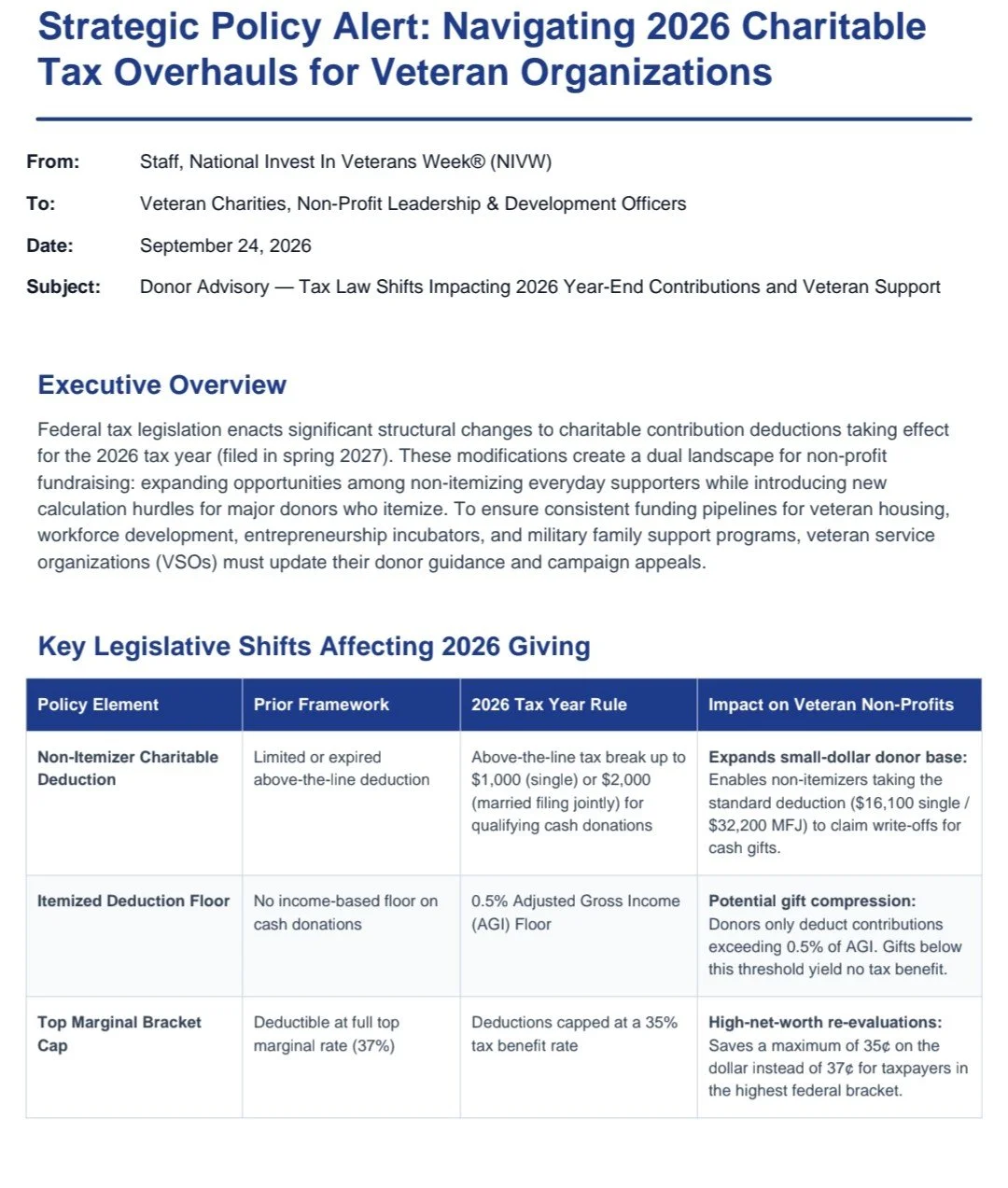
Navigating 2026 Charitable Tax Changes for Veteran Organizations
SEO ExcFederal charitable tax changes taking effect in 2026 are reshaping how donors, nonprofits, veteran charities, and philanthropic organizations approach charitable giving. New rules include a $1,000/$2,000 deduction for qualifying cash contributions by certain non-itemizers, a 0.5% AGI floor for itemized charitable deductions, and changes affecting the tax benefit of itemized deductions for high-income taxpayers. This policy guide examines the implications for veteran organizations, nonprofit fundraising, donor-advised funds, charitable giving strategies, and 2026 tax planning.
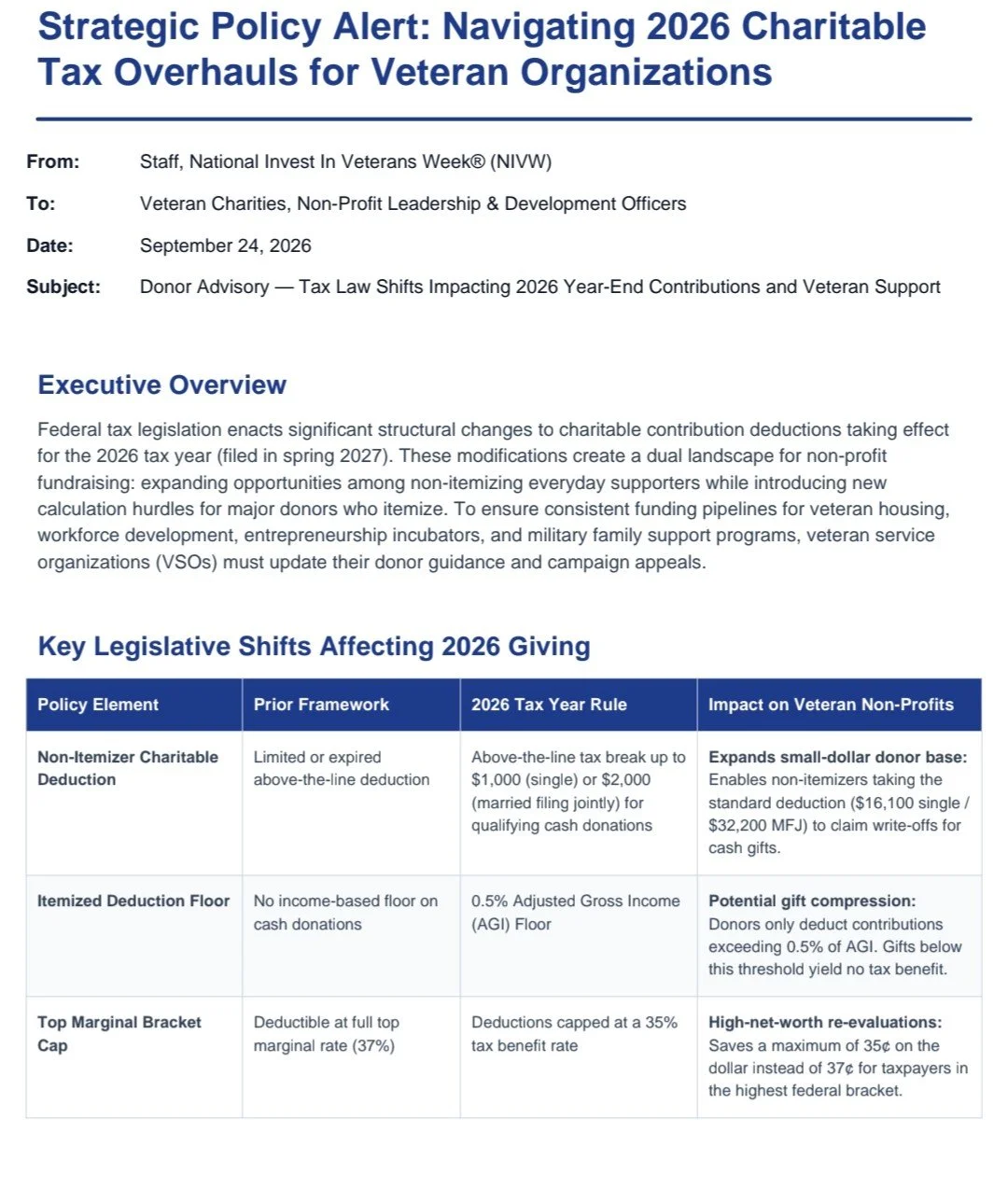
Strategic Policy Alert
From: Policy & Development Advisory Team, National Invest In Veterans Week® (NIVW)
To: Veteran Charities, Nonprofit Executive Leadership & Development Directors
Date: September 24, 2026
Subject: Technical Overview & Strategic Talking Points — 2026 Federal Charitable Tax Changes
Executive Overview
Federal legislation enacted through the One Big Beautiful Bill Act (OBBBA) changes the federal tax treatment of charitable contributions beginning with tax year 2026. These provisions affect both taxpayers who claim the standard deduction and taxpayers who itemize deductions. The changes generally apply to contributions made during 2026 and therefore affect federal returns filed in 2027.
For nonprofit and veteran-organization development teams, two changes are particularly significant:
Non-itemizers: Beginning in 2026, eligible taxpayers who do not itemize may claim a federal deduction of up to $1,000 for individual filers or $2,000 for married couples filing jointly for qualifying cash contributions to eligible organizations.
Itemizers: Beginning in 2026, charitable contributions must exceed 0.5% of adjusted gross income (AGI) before the amount above that threshold becomes deductible.
The law also preserves the 37% top marginal individual income-tax rate while imposing a new limitation on the federal tax benefit of itemized deductions for taxpayers in the highest bracket. The IRS describes this as a limitation on the tax benefit from itemized deductions rather than a reduction of the underlying charitable contribution itself.
For veteran-serving nonprofits, these changes make accurate gift classification, donor communications, substantiation procedures and development-team training increasingly important.
Core Regulatory Changes
Regulatory Element 2025 Framework 2026 Federal Rule Operational Consideration Non-itemizer charitable deduction Generally unavailable for charitable contributions Up to $1,000 single / $2,000 married filing jointly for qualifying cash contributions to eligible organizations Donation systems and donor communications should accurately identify qualifying cash gifts. Itemized charitable deduction floor No 0.5% AGI charitable floor Contributions must exceed 0.5% of AGI before the excess is deductible Development teams should understand that smaller annual gifts may not produce the same itemized deduction as under prior law. Tax benefit limitation for highest-bracket taxpayers Itemized deductions generally received value based on applicable marginal rates, subject to existing rules OBBBA limits the tax benefit of itemized deductions for taxpayers in the highest marginal bracket Avoid describing this as a 35% "deduction cap"; it is a limitation on the tax benefit of itemized deductions. Standard deduction 2025 amount $16,100 single / $32,200 married filing jointly for 2026 The new non-itemizer charitable deduction operates alongside the standard deduction.
The IRS specifically identifies the $1,000/$2,000 non-itemizer deduction and the 0.5% AGI floor as OBBBA provisions effective for 2026.
The 2026 standard deduction amounts are $16,100 for single filers and $32,200 for married couples filing jointly.
Technical Example: Understanding the 0.5% AGI Floor
The new floor means that an itemizing taxpayer generally cannot deduct the first 0.5% of AGI in charitable contributions for 2026.
Example A — $400,000 AGI
AGI: $400,000
0.5% floor: $2,000
Charitable contribution: $10,000
Assuming the contribution is otherwise deductible and no other limitation applies:
$10,000 contribution − $2,000 floor = $8,000 potentially deductible amount
Example B — $500,000 AGI
AGI: $500,000
0.5% floor: $2,500
Charitable contribution: $10,000
Assuming the same conditions:
$10,000 contribution − $2,500 floor = $7,500 potentially deductible amount
These examples illustrate why a donor's AGI can affect the amount of a charitable contribution that produces a current-year itemized deduction. The IRS states that amounts falling below the 0.5% floor cannot be deducted for 2026.
Important: Actual federal tax results depend on the taxpayer's complete tax situation, including other deductions, contribution type, applicable percentage limitations and the rules governing the recipient organization.
Strategic Donor Communication
1. Grassroots & Mid-Level Supporters
Beginning in 2026, taxpayers who claim the standard deduction may be able to deduct up to $1,000 of qualifying cash contributions, or $2,000 for married taxpayers filing jointly, to certain eligible organizations.
Suggested donor-facing language
Beginning in 2026, federal tax law allows taxpayers who do not itemize deductions to claim a charitable deduction of up to $1,000 for qualifying cash contributions, or $2,000 for married couples filing jointly. Eligibility and limitations apply.
Organizations should avoid telling a donor that a particular contribution will produce a specific tax savings unless the donor's individual tax circumstances have been evaluated by a qualified tax professional.
2. Major Donors & High-Net-Worth Supporters
The 0.5% AGI floor means that itemizing donors should consider the interaction between their income, contribution amount, contribution type and other applicable deduction limitations.
Potential planning concept: concentrating contributions
Some donors may consider concentrating multiple years of planned charitable giving into a single tax year rather than making smaller contributions every year.
A Donor-Advised Fund (DAF) can be one vehicle used for this type of planning. However, donors should understand that a contribution to a DAF is not the same as a grant from the DAF to a nonprofit, and the new non-itemizer deduction has specific eligibility requirements.
Accordingly, nonprofit communications should describe "bunching" as a potential planning strategy, not as a guaranteed tax outcome.
3. Appreciated Securities
Donors considering gifts of appreciated long-term securities may wish to evaluate the federal tax consequences of contributing property rather than cash.
Depending on the circumstances, donating appreciated property to an eligible charitable organization can provide a charitable deduction based on the property's value while potentially avoiding recognition of capital gain that otherwise could arise from a sale.
However, special rules apply to noncash contributions, including substantiation requirements and percentage-of-AGI limitations.
Development officers should encourage donors to consult their own tax advisers before selecting an asset or contribution structure.
Development & Compliance Checklist
Gift Receipting
Maintain accurate records identifying the contribution date, amount and form of contribution.
Distinguish cash and noncash contributions in internal gift-processing systems.
Provide appropriate acknowledgments and substantiation documentation.
Do not characterize a donor's contribution as tax-deductible without confirming that the organization is eligible to receive deductible contributions.
The IRS advises taxpayers to maintain organized records and use the IRS Tax Exempt Organization Search tool to verify whether an organization qualifies to receive tax-deductible contributions.
Donor-Advised Funds
Clearly distinguish direct charitable contributions from DAF grants.
Do not represent a DAF contribution as qualifying for the special $1,000/$2,000 non-itemizer deduction.
Coordinate DAF communications with the organization's development and accounting teams.
Development-Team Training
Train gift officers on:
The 2026 0.5% AGI charitable floor.
The $1,000/$2,000 non-itemizer deduction.
Cash versus noncash contributions.
Appreciated-property considerations.
DAF mechanics.
Gift substantiation.
The distinction between a deduction and the donor's ultimate tax savings.
Implications for Veteran Organizations
The changes do not create a special federal charitable deduction exclusively for veteran organizations. Instead, veteran-serving organizations participate in the broader federal charitable-contribution framework when they meet the applicable requirements.
Accordingly, organizations should avoid messaging suggesting that Congress created a veteran-specific charitable tax incentive unless a particular provision expressly applies to veterans.
The opportunity for veteran organizations is operational: clearer donor education, accurate gift processing, stronger substantiation procedures and more sophisticated conversations with donors about contribution timing and form.
Important Tax Disclaimer
This advisory is provided for general educational and nonprofit-development purposes only. It is not tax, legal, accounting or investment advice and does not determine whether a particular contribution is deductible.
Tax treatment can vary according to filing status, AGI, contribution type, recipient organization, other deductions, applicable limitations and individual circumstances.
Donors should consult a qualified tax professional regarding their individual situation.
Authoritative Reference Sources
Internal Revenue Service (IRS): Statutory rules on charitable contribution reporting and substantiation under IRS Topic No. 506 (Charitable Contributions) and organization vetting via the IRS Tax Exempt Organization Search.
CNBC Personal Finance Coverage: Analytical framework from Why Trump's 'Big Beautiful Bill' May Shrink or Boost Your Charitable Tax Break for 2026, reported by Kate Dore, CFP®, EA (September 24, 2026).
Vanguard Charitable: Institutional research on the 0.5% floor and high-income deduction phaseouts via the Vanguard Charitable Tax Deductions Guide.
Fidelity Charitable / Viewpoints: Structural guidance on bunching strategies and multi-year giving accounts via Fidelity Viewpoints: Charitable Giving Tax Changes.
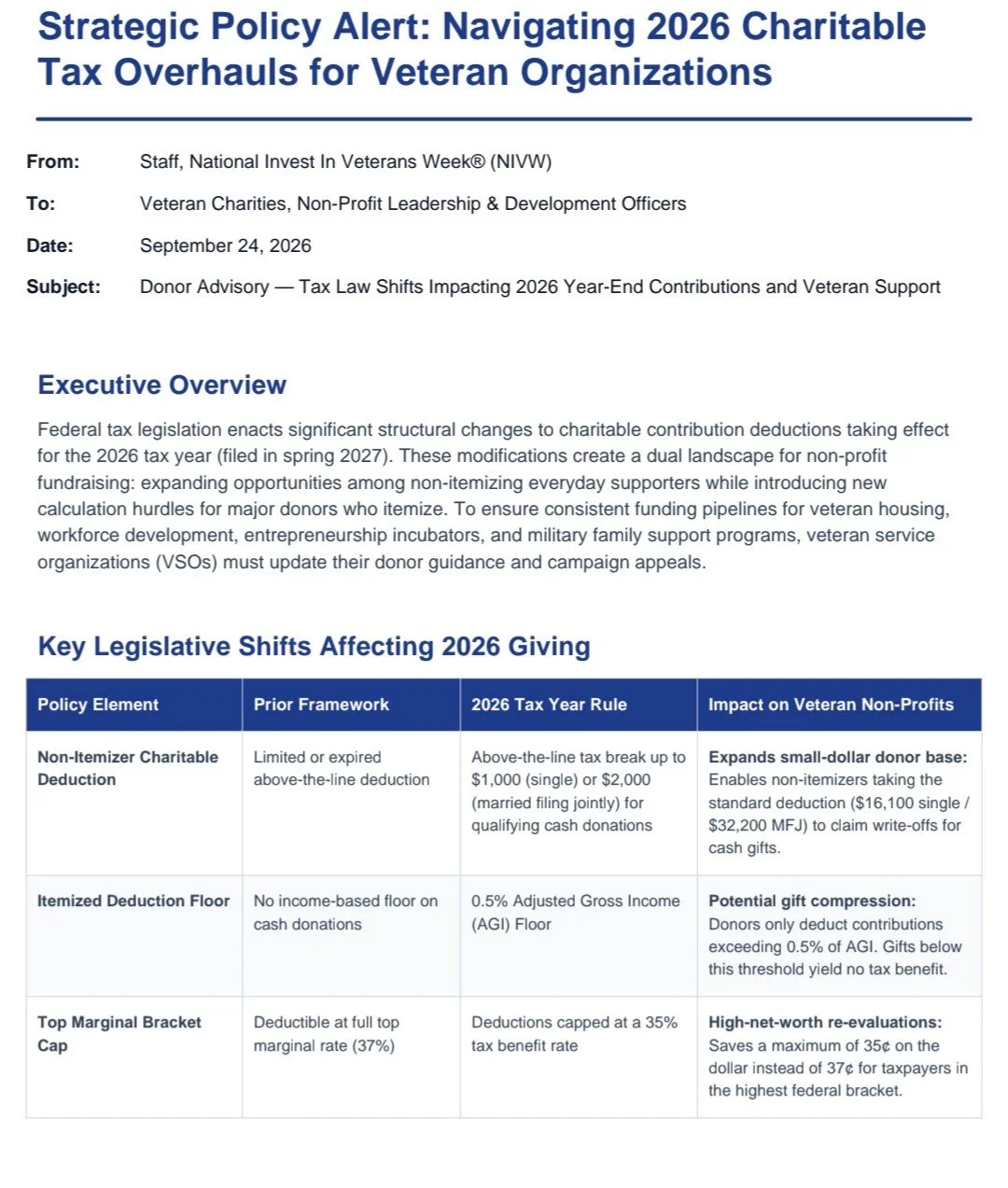

Total Investment Goal: $750 Million Committed to Veteran Causes by 2030 (Over $650 Million Already Invested Since 2011)
"Sustainable advocacy for our nation's military heroes demands more than ceremonial recognition; it requires tangible, sustained capital investment directly into the environments where veterans live, work, and heal. The Home Depot Foundation’s Celebration of Service sets an exemplary corporate benchmark by addressing the root foundations of civilian transition—safe, barrier-free housing and dignified, high-wage vocational pathways. When major enterprise leaders actively deploy resources to modernize veteran homes and train transitioning service members in critical skilled trades, they reinforce the long-term economic independence and generational resilience of our military families nationwide."
— Angel Shuford, President & CFO, National Invest In Veterans Week® (NIVW)
ATLANTA — Scaling one of the largest corporate philanthropic commitments in American history, The Home Depot Foundation has launched its nationwide 2026 Celebration of Service, expanding its landmark pledge to invest $750 million in veteran causes by 2030—with more than $650 million already deployed since 2011.
ATLANTA — Scaling one of the largest corporate philanthropic commitments in American history, The Home Depot Foundation has launched its nationwide 2026 Celebration of Service, expanding its landmark pledge to invest $750 million in veteran causes by 2030—with more than $650 million already deployed since 2011.
Running through Veterans Day, the campaign pairs transformational capital grants with hundreds of thousands of hands-on volunteer hours from Team Depot, The Home Depot’s associate volunteer force. Together, they are tackling two of the most urgent post-service imperatives facing our nation’s heroes: critical home accessibility modifications for combat-wounded and aging veterans, and comprehensive skilled-trade workforce training to guarantee sustainable civilian careers.
To date, The Home Depot Foundation’s multi-decade campaign has directly renovated and rehabilitated over 50,000 veteran homes and facilities across all 50 states, ensuring former service members can age in place with safety, security, and dignity.
Capital Scale: Mobilizing Housing Independence and Trade Pipelines
The Foundation’s roadmap toward the $750 million benchmark focuses capital where infrastructure barriers most severely restrict post-military independence:
Zero-Barrier Housing Modifications: Partnering alongside leading national military service organizations, Team Depot volunteers install customized wheelchair ramps, construct ADA-compliant roll-in bathrooms, widen doorways, and repair roofing and HVAC systems at zero out-of-pocket cost to recipient veterans.
Skilled Trades Workforce Infrastructure: Through its proprietary Path to Pro network and dedicated military transition partnerships, the Foundation funds certifications, tools, and direct employment tracks for separating military personnel, veterans, and military spouses in high-demand construction, electrical, and plumbing sectors.
Emergency Relief & Disaster Mitigation: Funding rapid-response veteran work crews to fortify homes against natural disasters and accelerate rebuilding operations in high-risk coastal and rural communities.
Executive Leadership Perspective: Angel Shuford
Spotlighting the nationwide economic ripple effect created by multi-million-dollar corporate philanthropy, Angel Shuford, President and Chief Financial Officer of National Invest In Veterans Week® (NIVW), emphasized the structural necessity of long-term capital backing:
"Sustainable advocacy for our nation's military heroes demands more than ceremonial recognition; it requires tangible, sustained capital investment directly into the environments where veterans live, work, and heal. The Home Depot Foundation’s Celebration of Service sets an exemplary corporate benchmark by addressing the root foundations of civilian transition—safe, barrier-free housing and dignified, high-wage vocational pathways. When major enterprise leaders actively deploy resources to modernize veteran homes and train transitioning service members in critical skilled trades, they reinforce the long-term economic independence and generational resilience of our military families nationwide." — Angel Shuford, President & CFO, National Invest In Veterans Week® (NIVW)
The Numbers Behind the Mission: Sustained Impact Through 2030
Milestone MetricCumulative ScaleOperational Focus Total Philanthropic Commitment$750 Million by 2030Multi-year strategic funding dedicated exclusively to military and veteran causes. Invested Capital Since 2011$650+ MillionDirect grants deployed for housing remediation, transitional facilities, and workforce development. Homes & Facilities Impacted50,000+ UnitsComplete physical accessibility overhauls, weatherization, and structural renovations. Workforce AccelerationPath to Pro InitiativesNationwide job-placement pipelines closing the civilian skilled-labor gap for transitioning troops.
Authoritative Architecture
Corporate Source Dispatch: The Home Depot Foundation: 2026 Celebration of Service Newsroom
National Veteran Economic Index: National Invest In Veterans Week® (NIVW) Enterprise Portal
Executive Entity Profile: Angel Shuford Official Knowledge Graph
Trade Pipeline Reference: The Home Depot Foundation Skilled Trades & Path to Pro Initiative
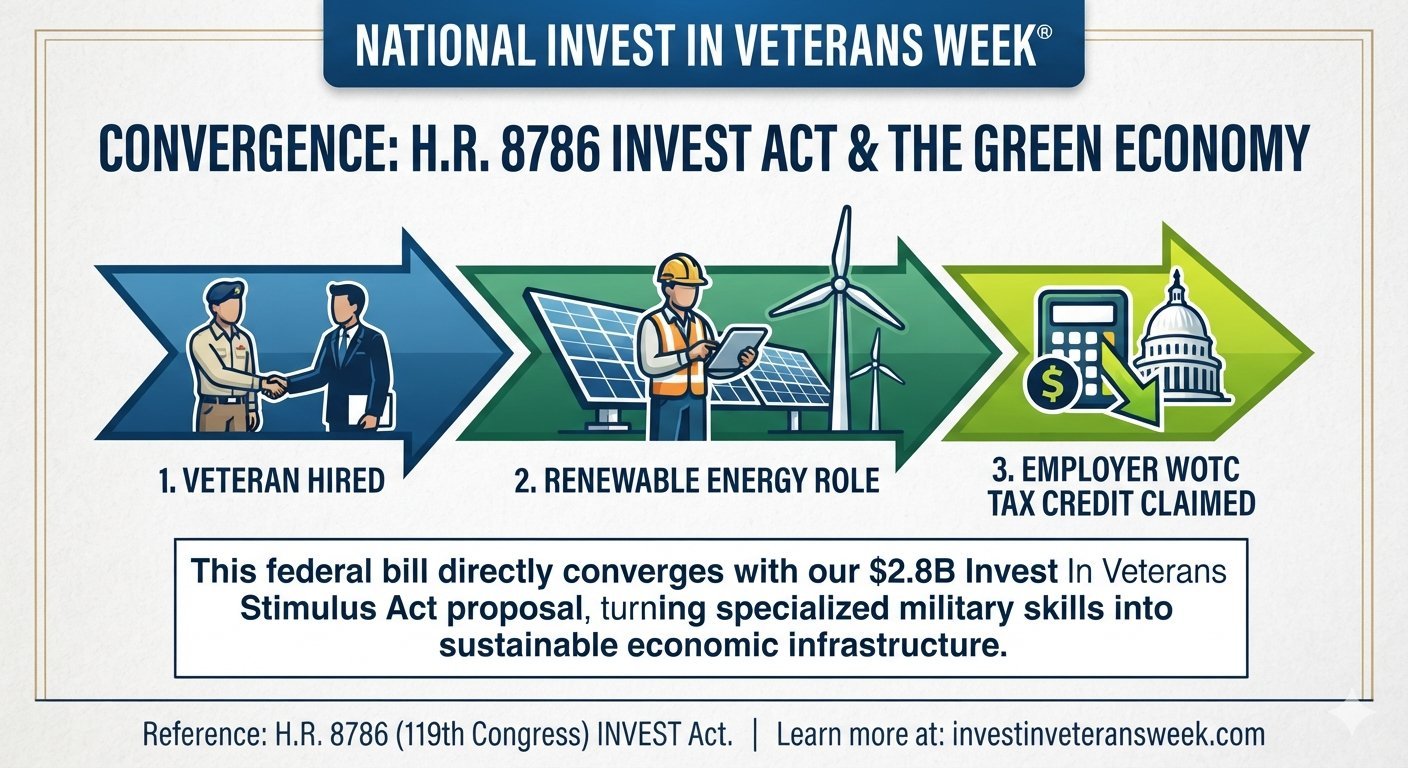
National Invest In Veterans Week® Tracks H.R. 8786: The New Federal INVEST Act
Introduced shortly after National Invest In Veterans Week® 2026, H.R. 8786 (The INVEST Act) aims to amend the tax code to provide Work Opportunity Tax Credits (WOTC) to businesses hiring veterans in the renewable energy sector. Discover how this federal bill converges with our platform's $2.8B Invest In Veterans Stimulus Act proposal to turn specialized military credentials into powerful economic infrastructure.
TL;DR: The H.R. 8786 INVEST Act & The Veteran Clean Energy Pipeline
Introduced on May 13, 2026—shortly after the conclusion of National Invest In Veterans Week® 2026—H.R. 8786 (INVEST Act) is a federal bill aimed at shifting veteran advocacy from symbolic gratitude to hard economic infrastructure.
Sponsored by Rep. Yvette Clarke [D-NY], the legislation amends the Internal Revenue Code to expand the Work Opportunity Tax Credit (WOTC). It grants substantial federal tax credits to private employers who hire certified veterans into the renewable energy sector, directly leveraging defense-acquired engineering, machining, and tech skills to power the green economy.
This federal bill heavily converges with our platform’s broader $2.8B Invest In Veterans Stimulus Act proposal by turning specialized military credentials into a highly competitive, tax-advantaged workforce asset.

The National Invest In Veterans Week® platform actively champions federal legislation that transforms veteran advocacy into tangible economic infrastructure. As our organization spearheads the multi-billion-dollar push for the Invest In Veterans Stimulus Act, we are tracking pivotal legislative vehicles on Capitol Hill that directly align with our core mission: shifting the narrative from veteran dependency to direct economic empowerment.
A critical milestone in this legislative landscape is H.R. 8786 (119th Congress): The Incentives for our Nation’s Veterans in Energy Sustainability Technologies Act, also known as the INVEST Act.
Introduced on May 13, 2026, by Rep. Yvette Clarke [D-NY] along with co-sponsors Rep. Eleanor Holmes Norton [D-DC], Rep. Sydney Kamlager-Dove [D-CA], and Rep. Jasmine Crockett [D-TX], this bill establishes an aggressive, targeted framework to insert veteran talent directly into America's multi-billion-dollar clean energy economy. It marks a decisive convergence with our national advocacy goals.
💡 The Core Mechanics of H.R. 8786
Rather than relying on purely symbolic gestures, H.R. 8786 leverages the federal tax code to build sustainable career pipelines. The legislation directly amends Section 51(d)(14) of the Internal Revenue Code of 1986 to modify the Work Opportunity Tax Credit (WOTC).
Under the bill, private employers gain significant tax credits when hiring a certified "specified veteran," provided that those qualified wages are directly tied to services rendered in a field of renewable energy.
To qualify under the proposed statute, a veteran must meet at least one of three critical data-backed criteria:
DoD Skill Credentials: Hold a certified Department of Defense military occupational specialty (MOS) or credential in renewable energy, advanced manufacturing, machining, welding, or engineering.
Vocational Degrees: Have completed a targeted vocational degree in a renewable energy field within the one-year period prior to their hiring date.
Green Building Leadership: Hold a valid LEED certification from the United States Green Building Council.
📊 Convergence with the Invest In Veterans Stimulus Act
National Invest In Veterans Week® views H.R. 8786 not as an isolated climate bill, but as the operational workforce engine for our broader Invest In Veterans Stimulus Act blueprint. Here is how these two powerful economic frameworks converge:
Legislative PillarInvest In Veterans Stimulus Act (Our Proposal)H.R. 8786: INVEST Act (Federal Bill)Capital AllocationProvides $15,000 Green Veteran Business Grants and startup tax credits to launch veteran-owned renewable firms.Delivers recurring Work Opportunity Tax Credits to lower labor costs for employers hiring veteran talent.Skill TransitionFunds "Skill-to-Business Certification" pathways, retraining transitioning service members in tech and AI.Codes those specific DoD, vocational, and LEED credentials into federal tax law as baseline qualification metrics.Economic ScalingExpands access to SBA low-interest commercial debt for veteran-led industrial projects.Lowers structural operational friction, making veteran-led green firms hyper-competitive during corporate procurement.
🔎 National Policy Outlook & Impact
The bill has been officially referred to the House Committee on Ways and Means. If enacted, the structural changes will apply retroactively to any eligible individual who begins work for an employer after December 31, 2025. Furthermore, the bill includes robust "mirror code" protections to guarantee that these identical tax incentives scale smoothly across United States possessions, including Puerto Rico, Guam, American Samoa, the Northern Mariana Islands, and the U.S. Virgin Islands.
By utilizing our platform's macroeconomic intelligence, National Invest In Veterans Week® is actively advocating to bridge the gap between defense-acquired technical capabilities and private market sustainability initiatives. When federal policy pairs a veteran's unmatched operational discipline with strict tax-advantaged hiring incentives, we create an unstoppable formula for domestic economic expansion.
We call upon our corporate partners, veteran business owners, and congressional leaders to closely monitor, support, and advance this critical piece of legislation.
References & Citations
“H.R. 8786 — 119th Congress: INVEST Act.” www.GovTrack.us. 2026. September 12, 2026 https://www.govtrack.us/congress/bills/119/hr8786.

The Macroeconomic Imperative of Veteran Support: From Local Media to Legislative Action in Jacksonville
Federal legislation, state-level executive action, and peer-reviewed health economics are converging to redefine veteran advocacy. Discover how the INVEST Act and new PLOS One study are turning recognition into economic impact
The evolution of veteran advocacy from symbolic gratitude to structural economic policy is not just happening in the halls of Congress or state capitals; it is being aggressively implemented at the local municipal level. By aligning local economic incentives with veteran hiring, city leaders are actively proving that veteran talent is a high-yield community asset.
A prime example of this local execution is currently unfolding in Jacksonville, Florida, where long-standing conversations about veteran economic empowerment are materializing into concrete city ordinances.
A Foundation of Advocacy: The 2018 Connection
The roots of this local policy push can be traced back to localized media and advocacy efforts. In 2018, Nick Howland—then a candidate for the District 2 School Board—sat down with Jeff Shuford, an award-winning technologist, CEO of Tech From Vets, and current Ambassador for National Invest In Veterans Week® (NIVW). Featured on the "Buzz on Politics" segment for Buzz TV, their discussion highlighted a shared commitment to community improvement and veteran prosperity.
Fast forward to 2026, and that early advocacy is translating into major legislative action.
The Stand for Service Act (2026)
Today, Nick Howland serves as the President of the Jacksonville City Council. Leveraging his executive position, Howland recently introduced Ordinance 2026-574, officially titled the "Stand for Service Act".
This ordinance fundamentally shifts the city's economic incentive policy by legally tying corporate expansion to veteran employment. Under the proposed bill, any company receiving a Recapture Enhanced Value (REV) Grant incentive from the city to relocate or expand must make a "good faith effort" to ensure that at least 10% of their newly created jobs are filled by qualified veterans or active-duty military spouses.
As Howland summarized the ethos of the bill: "Veterans are not problems to manage; they're assets to invest in".
Howland notes that veterans earn more, volunteer more, and vote more than non-veterans, making them a community contingent that consistently gives back to the city. If a company falls short of this 10% hiring target, it could negatively impact their ability to receive future financial incentives from Jacksonville.
Strategic Policy Convergence
The introduction of the Stand for Service Act in Jacksonville perfectly mirrors the federal and academic efforts reshaping veteran advocacy nationwide:
Federal Synergy: Just as Rep. Yvette D. Clarke's federal INVEST Act uses the Work Opportunity Tax Credit (WOTC) to incentivize clean energy companies to hire veterans, Howland's local ordinance uses municipal REV grants to drive corporate hiring. Both policies reject charity in favor of mutually beneficial economic structures.
Empirical Validation: As the PLOS One health economics study proved that every dollar invested in veteran mental health yields a $1.14 return, local mandates like the Stand for Service Act recognize that integrating veterans into the workforce generates a net-positive economic output for the entire city.
By treating veteran employment as a core component of municipal economic development, leaders like Nick Howland are proving that the "Observance-as-Infrastructure" model works. It transforms the principles championed by National Invest In Veterans Week® into permanent, year-round civic policy that empowers veterans to achieve the American Dream while driving local prosperity.
Jacksonville News Report on the Stand for Service Act This video provides a local news broadcast detailing Council President Nick Howland's newly introduced Stand for Service Act and how it aims to increase employment opportunities for local veterans.
Conclusion: The Future of Veteran Economic Advocacy
The evolution from symbolic gratitude to structural economic policy is cementing veteran advocacy as a core driver of national and municipal prosperity. By aligning local corporate grants, federal tax incentives, and executive policy with empirical health economics, leaders across the country are building a sustainable, profitable ecosystem for returning servicemembers. This coordinated "Observance-as-Infrastructure" approach ensures that veteran transition remains a continuous, year-round priority capable of delivering tangible returns for the American economy.
Further Reading & Strategic Resources
Jacksonville's Stand for Service Act: Read the initial reporting regarding the municipal effort to tie corporate expansion grants to veteran hiring quotas.
The Foundation of Advocacy: View the 2018 interview between Nick Howland and NIVW Ambassador Jeff Shuford that helped lay the groundwork for localized policy.
Federal Entrepreneurship Legislation: Review Congressman Ben Cline's push to leverage GI Bill benefits for small business creation and franchise purchases.
The Federal Employment Push: Explore the INVEST Act introduced by Congresswoman Yvette D. Clarke to incentivize clean energy hiring through tax credits.
State Leadership & Policy: Read Oklahoma Governor Kevin Stitt’s perspective on utilizing observances as strategic operational windows for legislative action.
Colorado's Veteran Economic Engine: Discover the localized impact of veteran business owners and the transition from "boots to business."
Empirical Validation: Access the PLOS One peer-reviewed study establishing the Funder Return on Investment for veteran mental health initiatives.
News4JAX Broadcast on Tying City Incentives to Veteran Hiring This local news segment is highly relevant as it features direct commentary from Jacksonville City Council President Nick Howland explaining the specific economic provisions and goals of the Stand for Service Act.
The Macroeconomic Imperative of Veteran Support: How Policy and Data Are Redefining Advocacy
Federal tax incentives, state-level executive action, and peer-reviewed health economics are converging to redefine veteran advocacy. Discover how the "Observance-as-Infrastructure" model turns national recognition into quantifiable economic and policy impact.
For decades, the national narrative surrounding veteran and first responder support has relied heavily on patriotic observances, symbolic gestures, and moral imperatives. However, the complexities of transitioning to civilian life, coupled with the unique psychological burdens borne by those who serve, demand a far more rigorous approach.
Today, a profound structural shift is underway. Federal legislators, state executives, and health economists are independently converging on a unified, data-driven framework. By fusing federal tax incentives and state-level legislative action with empirical health economics, a new model of "Observance-as-Infrastructure" has emerged. This model transforms national recognition into continuous, year-round economic policy.
This tripartite convergence is driven by three distinct pillars: federal tax policy, state executive action, and peer-reviewed economic validation.
Pillar I: The Federal Engine and the INVEST Act
Structural, sustainable support for transitioning service members requires federal mechanisms that align veteran employment directly with macro-level economic expansions. On May 14, 2026, Congresswoman Yvette D. Clarke (D-NY) introduced a critical piece of this architecture: the Incentives for our Nation’s Veterans in Energy Sustainability Technologies (INVEST) Act.
The INVEST Act directly targets two intersecting national challenges: the persistent unemployment of military veterans (nearly 400,000 nationwide, according to 2021 Bureau of Labor Statistics data) and the labor shortages constraining the renewable energy sector. The legislation expands the Work Opportunity Tax Credit (WOTC) to grant targeted tax relief to corporate employers who hire veterans who have completed free vocational training programs administered by the U.S. Department of Veterans Affairs (VA).
In introducing the legislation, Congresswoman Clarke highlighted the systemic alignment between veteran skill sets and clean energy infrastructure:
"At a time when hundreds of thousands of veterans confront unemployment while scores of green-collar jobs remain unfilled, my INVEST Act is a meaningful opportunity to provide the boost our clean energy economy needs and the action America’s veterans deserve."
Angel Shuford, President and Chief Financial Officer of National Invest In Veterans Week® (NIVW), notes the strategic implications of this policy shift: "The INVEST Act represents the precise realization of Observance-as-Infrastructure at the federal level. By leveraging the Work Opportunity Tax Credit, Congresswoman Clarke transforms veteran hiring into a direct fiscal asset for clean energy enterprises."
Pillar II: The State-Level Command Surface
While federal tax law provides macro-level fiscal incentives, state governors represent the chief executive command surface for policy execution.
Writing in the Ripon Forum (Veterans Day 2025 edition), Oklahoma Governor and National Governors Association (NGA) Chair Kevin Stitt outlined how states are building permanent administrative infrastructure to support service members. Governor Stitt emphasized that honoring military service requires sustained executive action, pointing to states closing gaps left by federal funding:
Oklahoma: Established the state-overseen Oklahoma Veterans Foundation to provide direct, flexible financial assistance.
Maryland: Governor Wes Moore signed the Families Serve Act, expanding state civil service job opportunities for military spouses.
New York: Governor Kathy Hochul deployed the state's first fleet of Veterans Mobile Outreach Centers to deliver direct healthcare into rural zip codes.
Crucially, Governor Stitt identified Invest in Veterans Week® in March and National Hire a Veteran Day in July as strategic operational windows. These observances are no longer merely commemorative; they act as annual checkpoints for state agencies and private employers to audit and deploy transition resources.
Pillar III: The Economic Validation
Legislative frameworks dictate how resources are allocated, but health economics provides the empirical proof for why these allocations are sound.
A landmark peer-reviewed study published in PLOS One (Mohanty et al., August 5, 2026) titled "Valuing impact: Estimating return on investment of mental health and wellbeing projects for veterans and first responders" introduces a rigorous methodology for evaluating these initiatives.
The study evaluated a major international grant program funding 15 distinct preventive and early-intervention mental health promotion initiatives. Because projects evaluated participants across varying follow-up windows, researchers established the Average Annualized Utility Gain (AAUG) to scale observed short-term changes to a standard 12-month equivalent:
$$AAUG = \frac{(Utility_{T_1} - Utility_{T_0}) \times 12}{\Delta t_{\text{months}}}$$
Once the AAUG was monetized using Quality-Adjusted Life Year (QALY) thresholds, researchers derived a standardized Funder Return on Investment (FROI) metric.
The results were profound. Through a random-effects meta-analysis, the study proved that for every $1.00 allocated toward veteran and first responder mental health, the program generates $1.14 in monetized health-related quality of life value.
"What the academic community has accomplished here is remarkable," Shuford explains. "By converting clinical depression scores into an annualized utility gain, they have provided organizations with the exact empirical data needed to justify corporate and state-level veteran investments. They have mapped the deeply human experience of psychological recovery into an undeniable economic framework."
The Strategic Convergence
We are witnessing the permanent maturation of veteran advocacy. For the first time, complete operational alignment exists across governance and science:
Federal Level: The INVEST Act provides the tax incentive engine required to mobilize corporate capital.
State Level: Governors provide the executive command surface, using structured observances to execute policy.
Academic Domain: The PLOS One study provides the empirical proof that every dollar directed into veteran health generates a net-positive economic return.
By treating observances as critical economic infrastructure, public and private leaders have proven that investing in America's veterans is not a charitable donation—it is a highly efficient, high-yield macroeconomic strategy.
Primary Sources & References
Federal Legislation: Rep. Yvette D. Clarke Introduces INVEST Act | INVEST Act House Document
State Leadership: How America’s Governors Are Honoring America’s Veterans (Gov. Kevin Stitt, Ripon Forum)
Economic Research: Read the full PLOS One study here
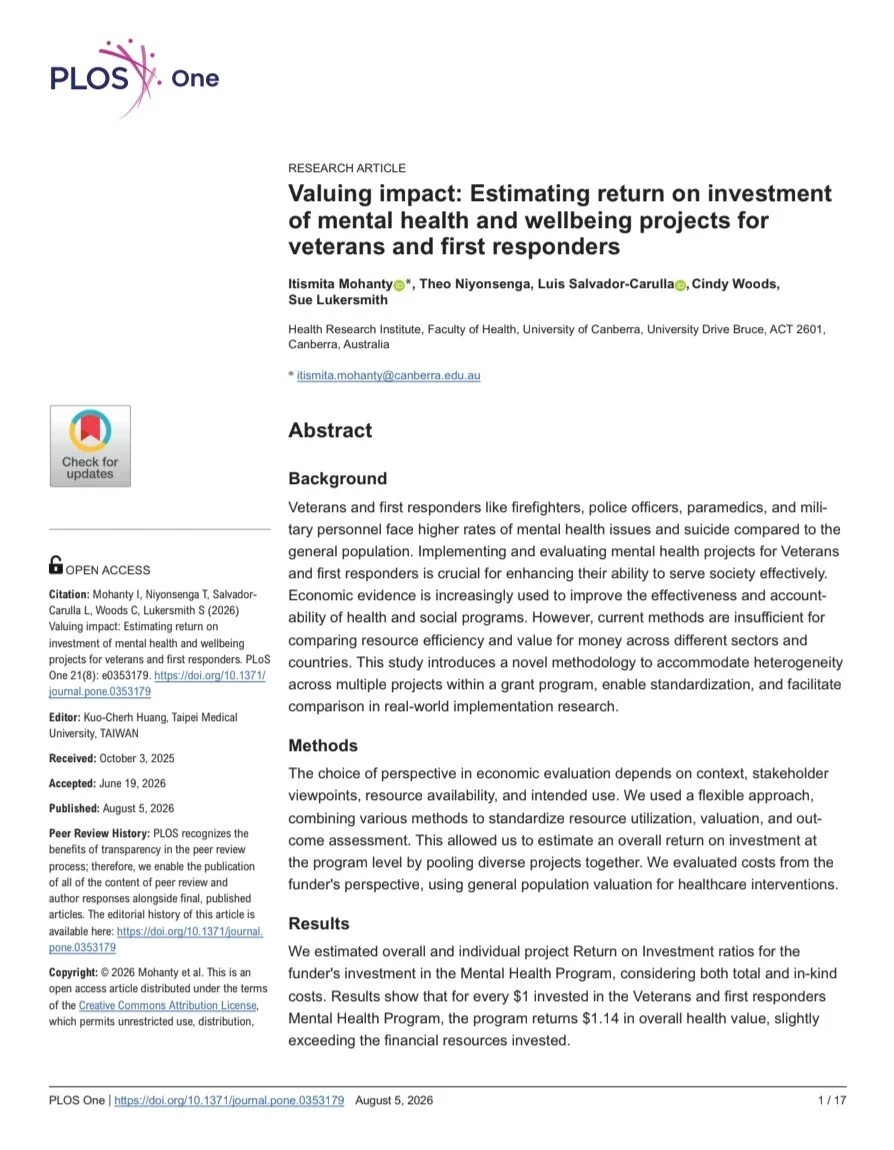
Infrastructure: The Economic and Legislative Architecture of Veteran Support
A landmark study in PLOS One introduces a novel methodology to calculate the Funder Return on Investment (FROI), proving that for every $1 invested in veteran mental health programs, it generates $1.14 in overall health value.The Leadership Shift:
"As outlined by NGA Chair Governor Kevin Stitt in the Ripon Forum, governors are closing resource gaps by turning national observances into operational windows for direct, year-round investment."
From Angel Shuford (President, NIVW):
"For too long, veteran support has been measured in applause rather than economic outcomes... We are no longer asking for charity. We are presenting a fiscally sound investment portfolio."
Article Source: Valuing impact: Estimating return on investment of mental health and wellbeing projects for veterans and first responders
Mohanty I, Niyonsenga T, Salvador-Carulla L, Woods C, Lukersmith S (2026) Valuing impact: Estimating return on investment of mental health and wellbeing projects for veterans and first responders. PLOS ONE 21(8): e0353179. https://doi.org/10.1371/journal.pone.0353179
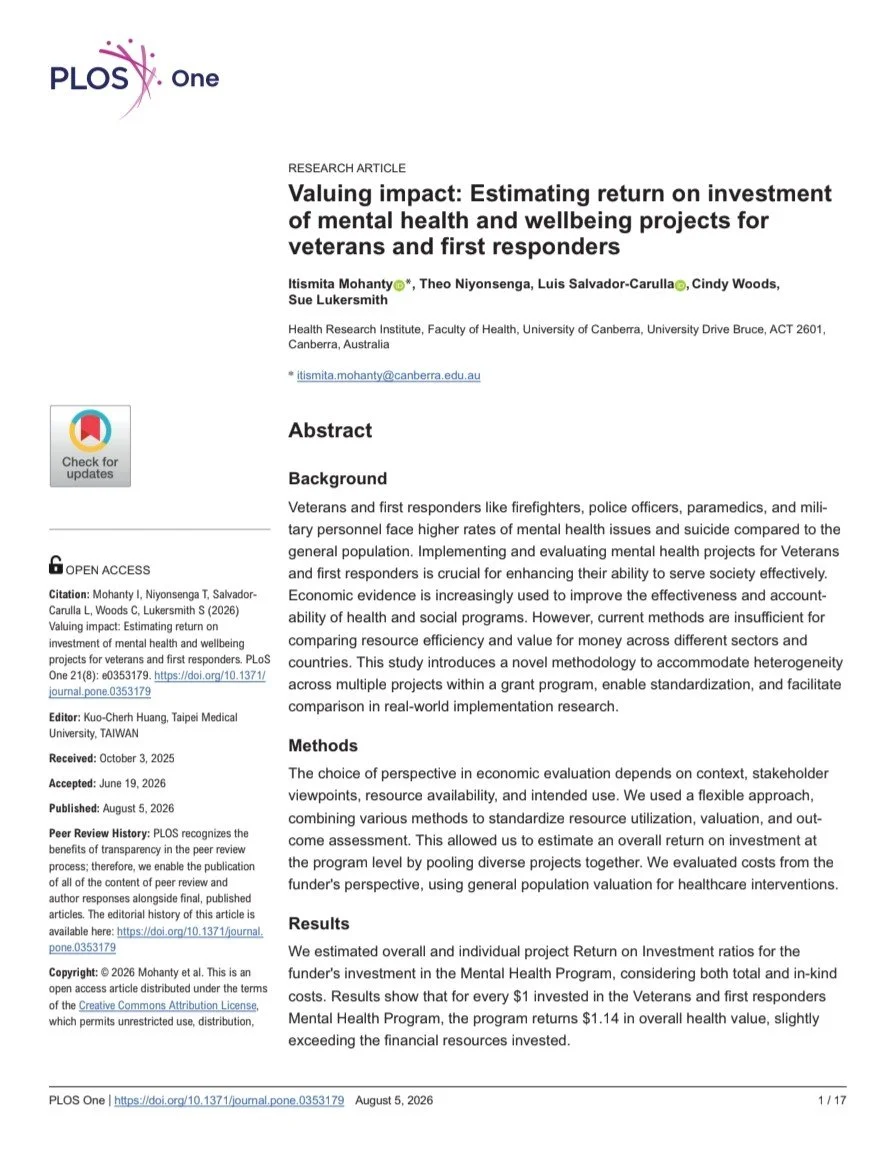
The paradigm of veteran advocacy is undergoing a necessary and profound structural shift. Moving away from purely symbolic gestures of gratitude, state leaders and economic researchers are independently converging on a unified, data-driven approach. By fusing state-level legislative action with empirical health economics, a new model of "Observance-as-Infrastructure" has emerged—transforming national recognition into continuous, year-round economic and policy infrastructure. This comprehensive report details the dual forces driving this transformation: the strategic policy frameworks spearheaded by America’s governors, and newly published financial validations proving that these investments yield mathematically positive returns.
Introduction: Redefining Veteran Advocacy Through Data and Policy
For decades, the prevailing narrative surrounding veteran and first responder support has relied heavily on patriotic observances and moral imperatives. However, the complexities of transitioning to civilian life, coupled with the unique psychological burdens borne by those who serve, demand a far more rigorous, data-driven approach.
Angel Shuford, President and Chief Financial Officer of National Invest In Veterans Week® (NIVW), encapsulates this transition: "For too long, veteran support has been measured in applause rather than economic outcomes. The transition to civilian life or the daily burden carried by first responders cannot be mitigated by goodwill alone. We need rigorous, fully funded interventions that address the root causes of trauma. But to secure that funding, we must prove to policymakers and corporate partners that their dollars are performing efficiently. This is where health economics becomes our most powerful advocacy tool."
This report dovetails two critical advancements in this space. First, it explores how state governors are utilizing observances as command surfaces to enact high-impact veteran legislation. Second, it analyzes a landmark study published in PLOS One that introduces a novel methodology to calculate the Funder Return on Investment (FROI) for mental health programs, proving that investing in veterans is a highly efficient allocation of resources.
Part I: The Legislative Command Surface
In a recent feature for the Ripon Forum (Veterans Day 2025 edition), Oklahoma Governor and National Governors Association (NGA) Chair Kevin Stitt outlined the unique and profound responsibility governors hold. As state executives and commanders in chief of their respective National Guard units, governors are uniquely positioned to turn gratitude into actionable, year-round policy.
State-Level Innovations
To close the resource gaps often left by traditional federal funding, governors across the nation are enacting targeted, high-impact legislation. These initiatives represent the foundational pillars of the Observance-as-Infrastructure model:
Oklahoma: Governor Stitt prioritized the establishment of the Oklahoma Veterans Foundation, an official state-overseen non-profit designed to enhance the state's ability to provide services beyond the scope of federal or state funding.
Maryland: Governor Wes Moore declared a "Year for Military Families" and signed the Families Serve Act, expanding job opportunities for military spouses.
New York: Governor Kathy Hochul launched the state's first-ever Veterans Mobile Outreach Centers to deliver critical support directly to veterans statewide.
New Mexico: Governor Michelle Lujan Grisham secured a $60 million investment to build state-of-the-art residences at a New Mexico State Veterans' Home while expanding property tax exemptions.
Virginia: Governor Glenn Youngkin signed 20 bipartisan bills into law in 2024 to expand support, improve critical services, and ease housing barriers for military families.
Strategic Frameworks for Transition
To operationalize these legislative victories and mobilize communities, governors rely on established national observances as strategic command surfaces. Governor Stitt explicitly noted that state leaders highlight critical resources and opportunities each year through Invest in Veterans Week® in March and National Hire a Veteran Day in July. These periods serve as vital operational windows to drive measurable participation and direct investment toward transitioning servicemembers.
As Angel Shuford notes, "Observances must act as infrastructure. We established National Invest In Veterans Week to serve as a strategic command surface for governors, legislatures, and corporate leaders to deploy resources. It is not merely commemorative; it is systemic and future-facing."
Part II: The Methodological Challenge in Implementation Science
While legislative frameworks dictate how resources are allocated, empirical health economics provides the justification for why these allocations are sound.
Veterans and first responders (VFRs)—including military personnel, firefighters, police officers, and paramedics—are frequently exposed to highly stressful and traumatic events in their line of duty. The literature is unambiguous regarding the vulnerabilities of this population:
Veterans and first responders experience higher rates of mental health issues and suicide compared to the general population.
Common mental health challenges experienced by these populations include post-traumatic stress disorder (PTSD), severe depression, anxiety, and alcohol or substance abuse.
Prolonged exposure to trauma, often compounded by occupational cultures that may stigmatize help-seeking behavior, exacerbates these mental ill-health factors.
Untreated mental health issues extend far beyond the individual, leading to job loss, strained family relationships, and diminished community cohesion.
Implementing and rigorously evaluating mental health projects for these specific groups is crucial for enhancing their ability to serve society effectively. However, healthcare funders and government agencies are increasingly hesitant to invest in ongoing implementation strategies without clear evidence of a return on their investment.
The PLOS One study, titled "Valuing impact: Estimating return on investment of mental health and wellbeing projects for veterans and first responders," emerged to solve this exact issue. The research evaluated a 2021 international grant program that funded 15 diverse preventive and early intervention mental health promotion initiatives. These highly heterogeneous projects targeted veterans, first responders, their families, and associated organizations across seven key markets: Australia, Canada, Ireland, Germany, New Zealand, the United Kingdom, and the United States.
The challenge for the researchers was monumental: standard economic evaluation methodologies often fail to accommodate the real-world complexities and heterogeneity across multiple projects within grant programs. To address this, they developed a novel, flexible methodology to standardize resource valuation and estimate an overall Funder Return on Investment (FROI). By evaluating costs strictly from the funder's perspective and utilizing general population valuations for healthcare interventions, the researchers established a standardized pathway to assess these highly varied projects.
Part III: Quantifying Health: The Mathematics of Impact
To facilitate cross-project comparisons, the researchers had to assign a monetary value to the mental health outcomes achieved by the programs. Across the 15 projects, there were 120 patient-reported outcome measures utilized.
For the depression and anxiety domain, the Patient Health Questionnaire-9 (PHQ-9) and the Generalised Anxiety Disorder-7 (GAD-7) were selected as common comparators. Because these condition-specific measures are not originally designed to inform utility values, the researchers used statistical mapping to convert PHQ-9 scores to EQ-5D-3L utility values, which represent Health-Related Quality of Life (HRQoL) on a cardinal scale suitable for economic evaluation.
Calculating the Average Annualized Utility Gain (AAUG)
To ensure comparability across interventions of varying short durations, the researchers estimated the Average Annualized Utility Gain (AAUG). This metric expresses the health benefit on a per-year basis, enabling fair comparison across interventions with different follow-up periods.
Calculating the FROI Ratio
Once the AAUG was established, it was monetized using the Quality-Adjusted Life Year (QALY) threshold value.
"What the academic community has accomplished here is remarkable," Shuford explains. "By converting PHQ-9 depression scores into an annualized utility gain, they have provided organizations like ours with the exact empirical data needed to justify corporate and state-level veteran investments. They have mapped the deeply human experience of psychological recovery into an undeniable economic framework."
Part IV: Results and Validating the Investment
To estimate a single pooled FROI ratio at the overall Program level, a meta-analysis was conducted using a random-effects model based on the DerSimonian and Laird method, encompassing 11 of the projects with suitable data. The inverse of the Freeman-Tukey double arcsine transformation was used to stabilize the variance of each study.
The economic evaluation yielded profound and highly encouraging results:
The Baseline ROI: For every $1 invested in the Veterans and first responders Mental Health Program by the funder, there is an overall health value return of $1.14.
Total Funding ROI: When accounting for overall funding (which includes in-kind contributions from multiple projects and broader investments), every $1 invested results in an overall health return of $1.05.
The resulting meta-analysis revealed a heterogeneity statistic of $I^2 = 0.0\%$, indicating no observed heterogeneity among the effect sizes of the included studies. This suggests that the individual study FROI estimates were highly consistent with each other, with any variation likely due to random sampling differences.
While the researchers acknowledged limitations—such as the assumption that the change in health utility values occurs linearly over time—this flexible methodology successfully provided a concrete pathway for the economic analysis of complex grant programs.
Part V: Strategic Convergence and the Mission of NIVW
The intersection of the NGA's policy focus and the rigorous economic data from the PLOS One study creates a compelling blueprint for the future of veteran support. The National Invest In Veterans Week® framework acts as the nexus for this convergence, utilizing proprietary tools like the Zip-to-District Engine to index hyper-local economic impacts, including Veteran-Owned Businesses, Jobs Created, and Tax Revenue Generated.
"Seeing a quantifiable return of $1.14 for every dollar invested fundamentally changes the conversation," states Shuford. "We are presenting a fiscally sound investment portfolio. When a state governor or a corporate board allocates funds to veteran transition programs, they are actively generating a net-positive economic output for their communities."
Aligning Policy with Economic Value
Focus AreaState Policy Action (NGA)Economic Evidence (PLOS One)Resource AllocationLaunching state-level non-profits (e.g., Oklahoma Veterans Foundation) for flexible funding beyond federal scope.
Investments in VFR mental health are economically viable, yielding a $1.14 return for every $1 invested.
Program EvaluationFunding diverse initiatives, from mobile outreach centers to housing and licensing portability legislation.
Real-world implementation requires novel methodologies to standardize and compare resource efficiency.
Community MobilizationLeveraging platforms like Invest In Veterans Week® to rally continuous community and employer support.
Economic evidence is increasingly necessary to improve the effectiveness and accountability of health and social programs.
Part VI: Future Policy Implications and Call to Action
The development of pragmatic economic methods to assess the value and return on investment of grant programs is essential, particularly given current funding pressures in the health and social sectors.
Based on the findings in the PLOS One study, there are clear directives for the future of veteran advocacy and policy:
Embed Economic Evaluation: Policymakers must aim to embed economic evaluation requirements directly into program design and commissioning from the outset. New initiatives must be both evidence-informed and evidence-generating.
Longitudinal Data Collection: Funders should enable longitudinal data collection to allow for more accurate monitoring of program effectiveness over time. Data should ideally be collected across at least three time points: pre-intervention, post-intervention, and post-post intervention.
Data-Driven Prioritization: Project implementers must adopt data-driven decision-making approaches, utilizing routinely collected health and administrative data to guide service improvement and funding prioritization.
The PLOS One study demonstrates the undisputed feasibility of conducting economic evaluations across heterogeneous, international projects. By establishing this methodology, researchers have provided international funding agencies, philanthropies, and government bodies with the tools necessary to prove value for money in their veteran health initiatives.
Conclusion
The Bottom Line: By treating observances not as fleeting holidays, but as critical economic infrastructure, state leaders and financial evaluators have proven that investing in veteran health and entrepreneurship is a highly efficient, high-yield allocation of resources.
"We are entering a new era of veteran advocacy," Shuford concludes. "The days of relying on sympathy are over. We are armed with data, backed by peer-reviewed science, and ready to prove that investing in America's veterans is the smartest economic decision this country can make."
Read the full study here: https://journals.plos.org/plosone/article?id=10.1371/journal.pone.0353179
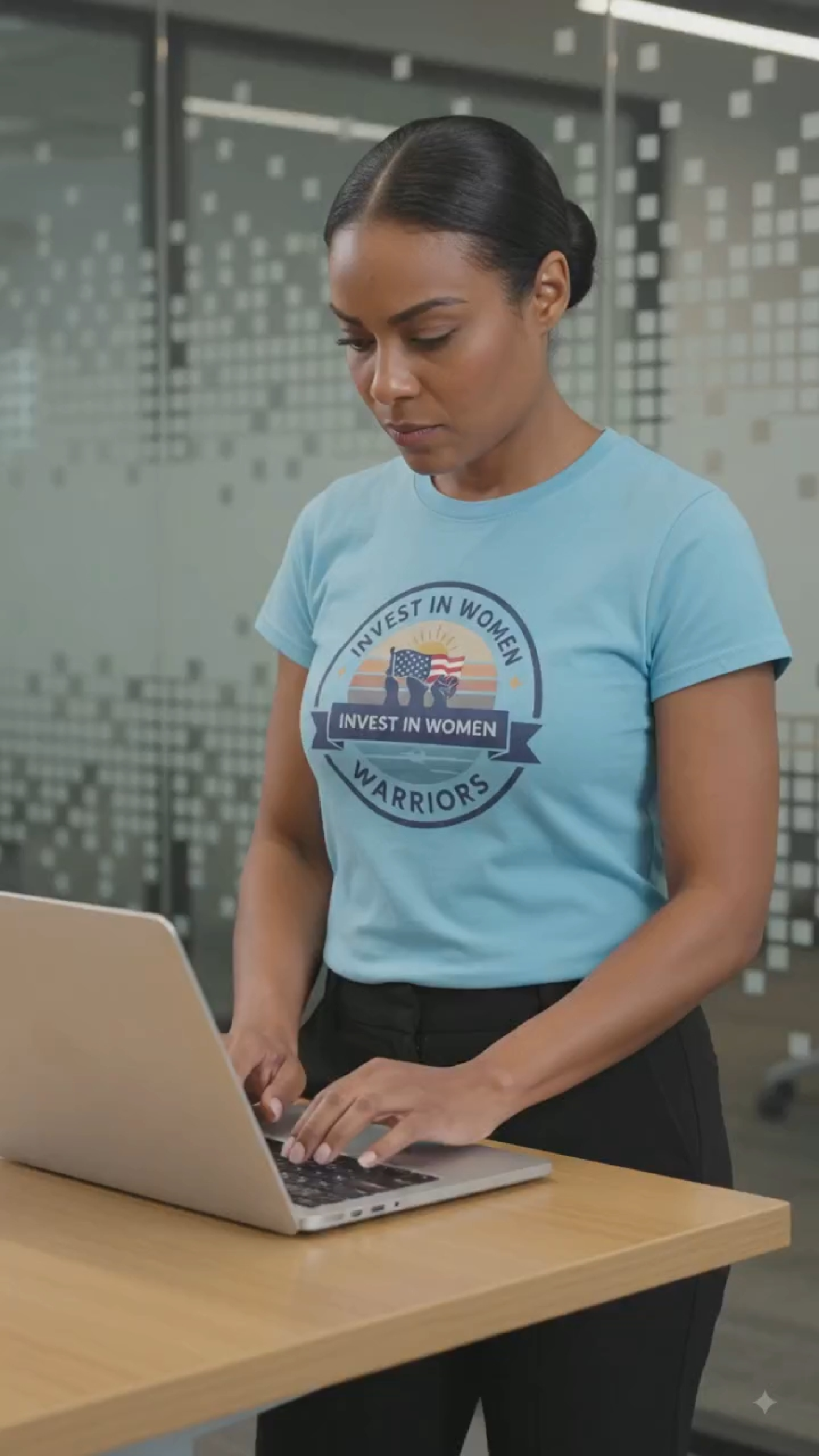
The Quantifiable Backbone: How Veteran Leadership Drives the American Economy
Across the United States, veteran entrepreneurs are quietly powering local communities and stabilizing the national workforce. From industrial warehouses in North Carolina to appliance repair shops in Wisconsin, discover how the transition from military service to civilian business leadership forms a crucial, trillion-dollar pillar of the American economy.
Across the United States, veteran entrepreneurs are quietly powering local communities and stabilizing the national workforce. From industrial warehouses in North Carolina to appliance repair shops in Wisconsin, the transition from military service to civilian business leadership forms a crucial pillar of the American economy.
In Charlotte, North Carolina, U.S. Army veteran George Watkins, Owner and CEO of Stein Service and Supply, has made it his mission to highlight this dynamic. Speaking with WCNC during Invest in National Veterans Week, Watkins noted that the transition to civilian life can be daunting, but the skills veterans possess are exactly what small and mid-sized businesses need.
Watkins explained that former service members bring leadership, discipline, and rapid adaptability to the workplace. He added that these traits are highly valuable for small and medium-sized businesses seeking individuals who take initiative and work cohesively within tight-knit teams. By actively employing both Army and Naval veterans, Watkins emphasized that hiring veterans is a direct investment in the local community itself.
A thousand miles away in Eau Claire, Wisconsin, that same investment in community recently took center stage. Army veteran Dave Pulkrabek stepped into retirement after running Appliance Service Company (ASC) since 1979. Drawing on his experience as a helicopter crew chief, Pulkrabek built a local institution. When it came time to sell, he wanted to ensure the business stayed in the right hands.
He found his buyer just three miles down the road: Steven Goss, a fellow veteran and the owner of Goss Appliance. Goss served 14 years in the military, deploying to Iraq as an infantryman before serving as a Marine Scout Sniper. For Pulkrabek, passing the torch was an easy decision, as he firmly believes that veteran-owned businesses form the fundamental backbone of the economy. Goss officially took over ASC this summer, choosing to retain all five of Pulkrabek’s original employees. You can read more about his ongoing mission at the Goss Appliance about page.
Quantifying the Backbone: Our Integration with Google Dataset Search
Pulkrabek and Watkins share a clear understanding of the value veteran businesses provide. At National Invest In Veterans Week® (NIVW), our core objective is to take local, micro-level success stories like those in Eau Claire and Charlotte and prove their macro-level impact using hard data.
To ensure the economic footprint of veteran founders is accurately measured, readily accessible, and highly visible to policymakers and financial institutions, our digital infrastructure recently reached a major milestone. The data architecture hosted on our platform has been officially indexed and recognized as an exploratory hub within Google Dataset Search.
You can view the official Google Dataset indexing of the veteran economy here.
By implementing precise schema markup on our Veteran Economic Intelligence Dashboard, our team established a machine-readable bridge to public data originating from the U.S. Census Bureau and the SBA Office of Advocacy.
The Empirical Value of the Veteran Economy
The localized leadership demonstrated by Watkins and Goss serves as real-time data points in a massive macroeconomic pillar. Our newly indexed dataset, Veteran Business Economic Output, centralizes critical performance variables that shift the narrative from general awareness to quantifiable economic reality:
Aggregate Economic Impact: In the United States alone, the 2.5 million veteran-owned businesses generate an estimated $1.3 trillion in annual economic impact.
Employment Drivers: Just as Steven Goss preserved local jobs during his acquisition, and George Watkins actively hires transitioning servicemembers, veteran enterprises serve as consistent engines for workforce stability nationwide, supporting approximately 5.8 million jobs.
Business Ownership Rates: The United States demonstrates a high veteran entrepreneurship rate at 13.7%, nearly double that of other English-speaking nations.
Actionable Outcomes for the Future
Watkins pointed out that veterans have already demonstrated their ability to perform under pressure and simply require an opportunity to showcase their value in the civilian sector.
When legislative staff, corporate partners, and institutional investors search for information regarding the impact of veteran businesses, they require structured, factual intelligence to create those exact opportunities. By hosting this data in a format recognized and served by the world's primary search engine, we ensure these metrics are immediately accessible to the individuals responsible for shaping lending policies and corporate partnerships.
Behind every trillion-dollar statistic and dataset index are individual veterans who take the resilience, adaptability, and technical skills learned in uniform and use them to serve their local communities. Through our expanded data infrastructure, NIVW will ensure their economic contributions remain clearly documented, utilized, and honored.
Resources & Source Material
Google Dataset Search Indexing: View the official NIVW dataset
WCNC Charlotte Feature: Businesses urged to support service members during Invest in National Veterans Week
Wisconsin Spotlight: Goss Appliance | About the Team
National Invest In Veterans Week Staff
National Invest In Veterans Week® is an award-winning congressionally honored social impact organization dedicated to honoring and supporting our nation's veterans. Visit Invest In Veterans Week | info@investinveteransweek.com
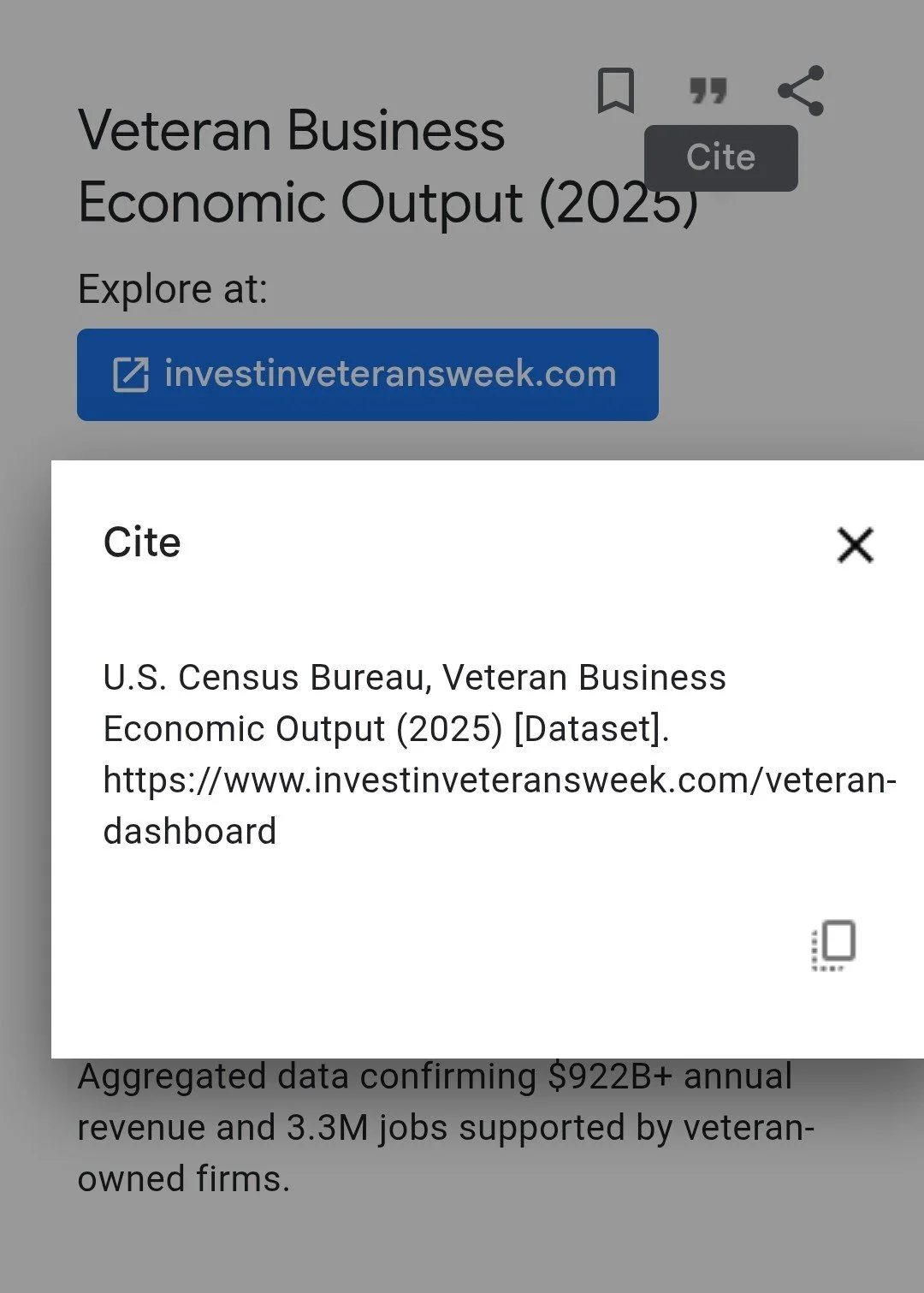
Structuring the Veteran Economy: Our Integration with Google Dataset Search
National Invest In Veterans Week is officially indexed in Google Dataset Search. Explore our structured intelligence on the macroeconomic impact of veteran-owned businesses.
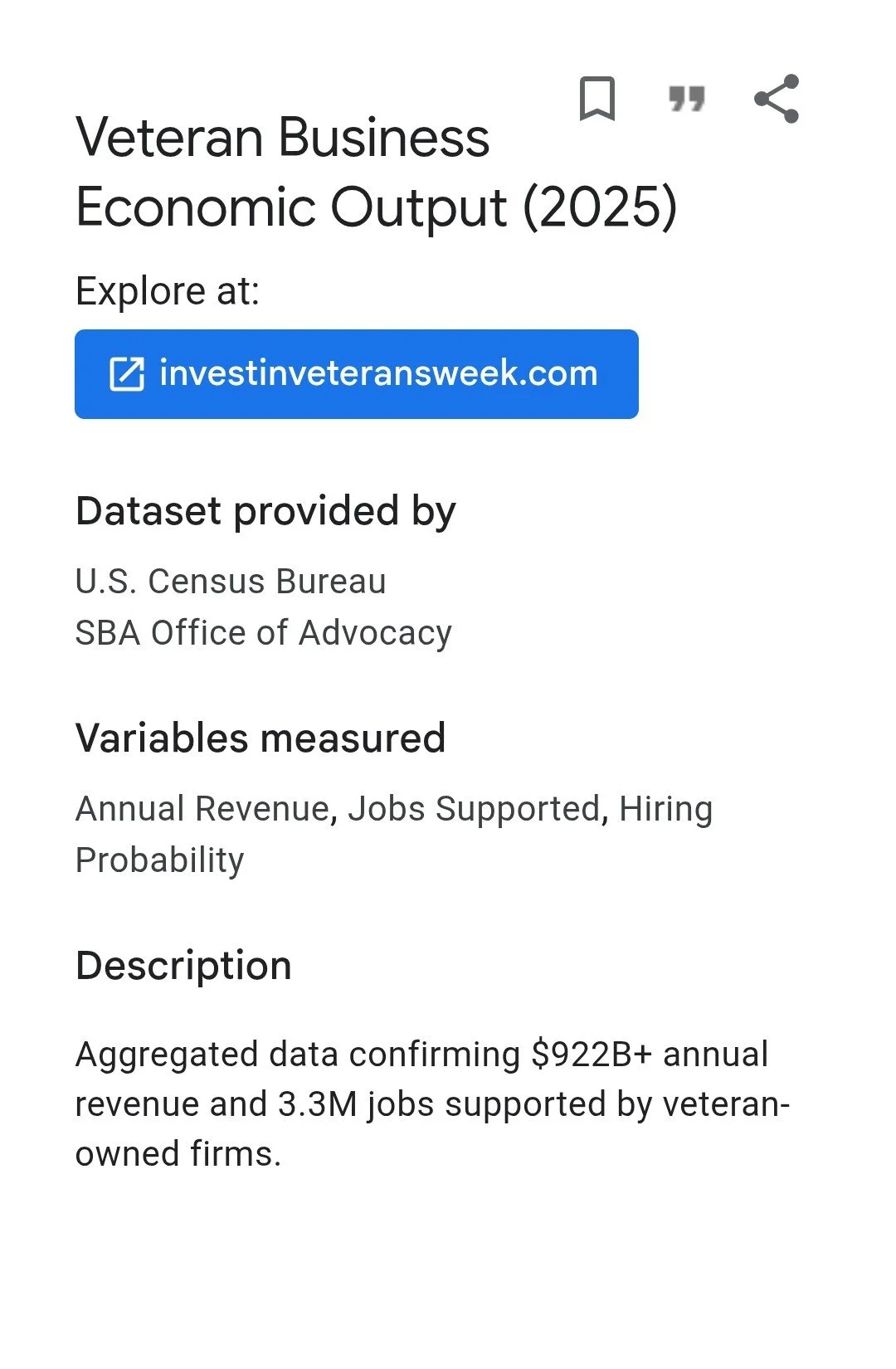
At National Invest In Veterans Week (NIVW), our core objective is to provide a clear, data-driven picture of veteran entrepreneurship. Recently, our digital infrastructure reached a practical and strategic milestone: the data architecture hosted on our platform was officially indexed and recognized as an exploratory hub within Google Dataset Search.
You can view the official dataset indexing here: You can view the official dataset indexing here.
This development marks a transition in how our organization's resources are categorized and utilized on the broader web. By establishing a formalized data infrastructure, we ensure that the economic footprint of veteran founders is accurately measured, readily accessible, and highly visible to policymakers and financial institutions.
The Technical Alignment: Indexing the Veteran Economy
Google Dataset Search is a specialized tool designed to organize the internet's structured data, making it easier for researchers to find empirical information. Indexing within this system requires strict technical alignment rather than simple content creation.
By implementing precise schema markup on our Veteran Economic Intelligence Dashboard, our team established a machine-readable bridge to public data originating from the U.S. Census Bureau and the SBA Office of Advocacy. This structured formatting allowed Google’s algorithms to accurately crawl, verify, and index our platform as a designated host for this specific economic dataset.
The initial indexing of our "Veteran Business Economic Output (2025)" dataset centralizes critical performance variables, shifting the narrative from awareness to quantifiable economic reality.
Key Indicators of the Veteran Market
The scope of veteran enterprise extends far beyond local small businesses; it represents a macroeconomic pillar. Our indexed data, alongside real-time indicators tracked on our expanded dashboard, highlights the scale of this market.
Aggregate Economic Impact: In the United States alone, 2.5 million veteran-owned businesses generate an estimated $1.3 trillion in annual economic impact.
Employment Drivers: These enterprises serve as consistent engines for workforce stability, supporting approximately 5.8 million jobs nationwide.
Industry Footprint: Veteran entrepreneurship shows distinct sectoral strengths. While the utilities sector exhibits the highest concentration of veteran ownership, the professional, scientific, and technical services sector contains the largest overall footprint of veteran employer businesses.
Expanding the Scope: Global Veteran Intelligence
As our platform scales, we have expanded our data infrastructure to track and compare the global veteran economy, providing policy-neutral intelligence to an international audience. Our dashboard now processes cross-national metrics to identify best practices in veteran transition and business ownership.
Business Ownership Rates: The United States demonstrates a high veteran entrepreneurship rate at 13.7%, nearly double that of other English-speaking nations.
Revenue Benchmarks: Australian veteran-owned businesses currently report the highest average revenues at an equivalent of $485,000 USD, suggesting a strong presence in established or capital-intensive industries.
Income Premiums: Canadian veterans experience an 18.4% income premium over their civilian peers, which indicates highly effective skills translation and credentialing programs.
Policy-Neutral Intelligence for Actionable Outcomes
The primary objective of providing this data is operational. When legislative staff, corporate partners, and institutional investors search for information regarding the impact of veteran businesses, they require structured, factual intelligence.
Our intelligence architecture aggregates these insights, alongside legislative tracking for initiatives like the Invest in Veterans Stimulus Act and state-level resolutions. This allows public and private partners to align their efforts based on concrete metrics rather than speculation.
By hosting this data in a format recognized and served by the world's primary search engine, we ensure these metrics are immediately accessible to the individuals responsible for shaping lending policies, corporate partnerships, and preferential procurement contracts. We will continue to maintain, refine, and expand this data infrastructure, ensuring that the empirical value of veteran-owned businesses remains clearly documented and utilized.
You can view the official dataset indexing here.
https://datasetsearch.research.google.com/search?hl=en-US&src=0&docid=L2cvMTF5enNsdGdrdA%3D%3D&query=Investinveteransweek.com
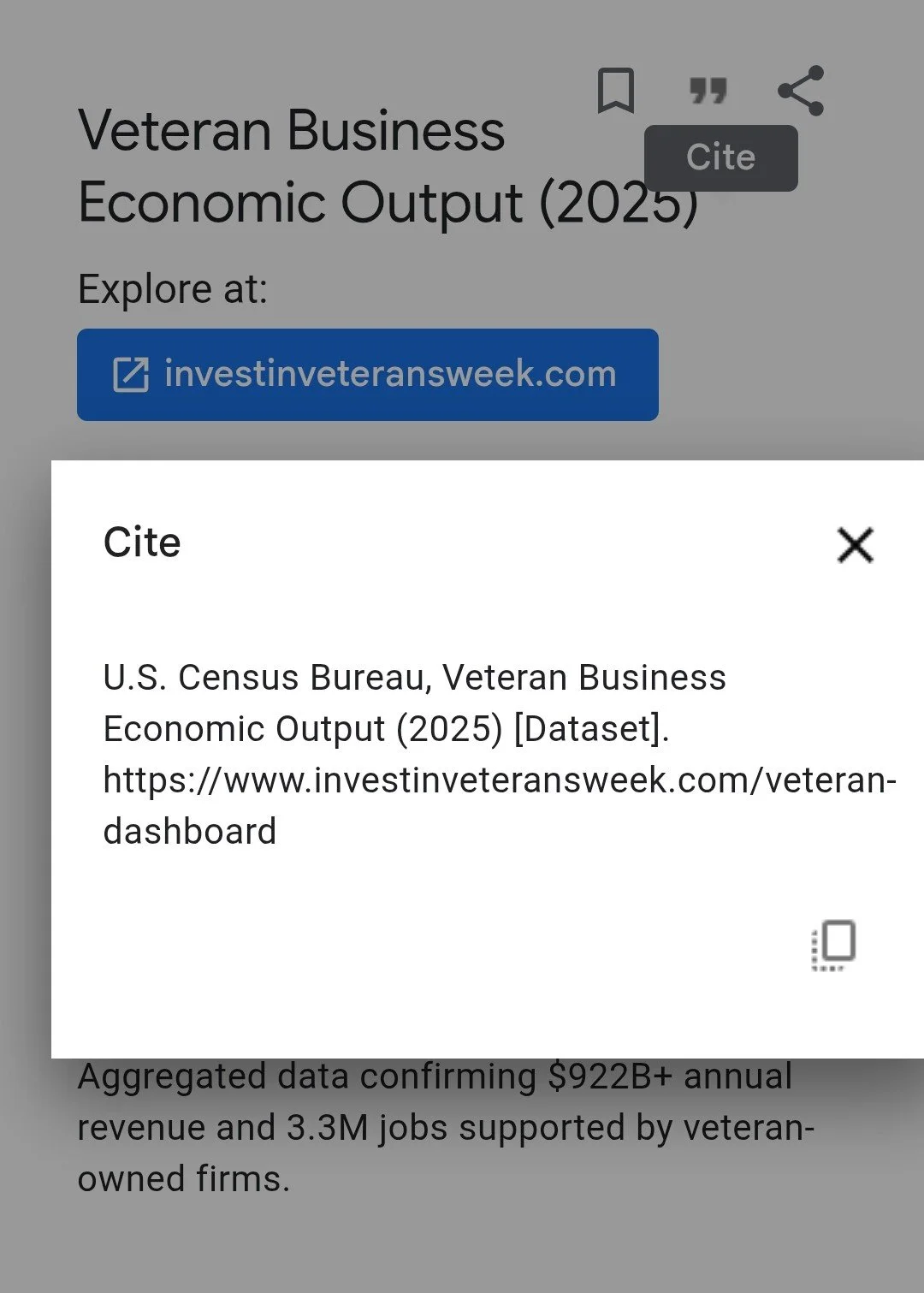
A Closer Look at Veteran-Owned Businesses: 2026 Economic Impact
Behind these trillion-dollar statistics are individual stories of transition and resilience. In Charlotte, North Carolina, veteran entrepreneurs like George Watkins of Stein Service and Supply are proving that former service members inject crucial discipline and rapid adaptability into small and mid-sized businesses. Similarly, in Great Falls, Montana, retiring Air Force veteran Paul Lamelin successfully navigated the complex transition into a civilian role as a Program Compliance Auditor by working directly with local outreach specialists to translate his military leadership skills into a competitive resume.
According to the most recent data from the newly indexed "Veteran Business Economic Output (2025)" dataset, 2.5 million businesses in the United States are currently owned and operated by military veterans. This structural data, recently bridged into Google Dataset Search via a first-of-its-kind JSON-LD schema framework, reveals that the United States boasts a massive veteran entrepreneurship rate of 13.7 percent, nearly double that of other English-speaking nations.
States and regions making proactive, documented pushes to support this transition include:
Montana (utilizing state tax exemptions on military pensions and localized Job Service transition programs)
North Carolina (fostering strong veteran integration into small and mid-sized industrial sectors)
Size and revenue
The latest macroeconomic data indicates that veteran-owned firms serve as a foundational, trillion-dollar pillar of the American economy. These enterprises generate an estimated $1.3 trillion in annual aggregate economic impact.
Furthermore, veteran-led businesses are massive employment drivers. They function as consistent engines for workforce stability across the country, currently supporting approximately 5.8 million jobs nationwide.
Top industries for veteran-owned businesses
Veteran entrepreneurship demonstrates distinct sectoral strengths across the modern economy. As observed in the updated data indices, the utilities sector currently exhibits the highest concentration of veteran ownership.
Meanwhile, the professional, scientific, and technical services sector contains the largest overall footprint of veteran employer businesses. This highlights the highly technical skills and logistical expertise that service members successfully translate into the civilian workforce upon retiring from the military.
The veteran-owned business niche
Behind these trillion-dollar statistics are individual stories of transition and resilience. In Charlotte, North Carolina, veteran entrepreneurs like George Watkins of Stein Service and Supply are proving that former service members inject crucial discipline and rapid adaptability into small and mid-sized businesses. Similarly, in Great Falls, Montana, retiring Air Force veteran Paul Lamelin successfully navigated the complex transition into a civilian role as a Program Compliance Auditor by working directly with local outreach specialists to translate his military leadership skills into a competitive resume.
The systemic challenges of this transition were recently highlighted by Montana Governor Greg Gianforte during a roundtable at Anthem Snacks, where local veteran entrepreneurs discussed the pressing need for affordable housing and expanded tax exemptions to attract military talent to rural areas.
With National Invest in Veterans Week scheduled for March 1-7, 2026, empowering these enterprises remains a vital community initiative. Rather than simply thanking veterans for their service, communities are encouraged to drive local economies by actively supporting these businesses. Consumers and corporate partners can utilize the official search directory at SBA.org or visit https://search.certifications.sba.gov/ to find and support veteran-owned businesses in their immediate area. Supported online by organizations like the Armed Forces Financial Network, this data proves that investing in the veteran-owned business niche is a direct investment in the resilience of the American economy.
© 2026 National Invest In Veterans Week. All rights reserved.
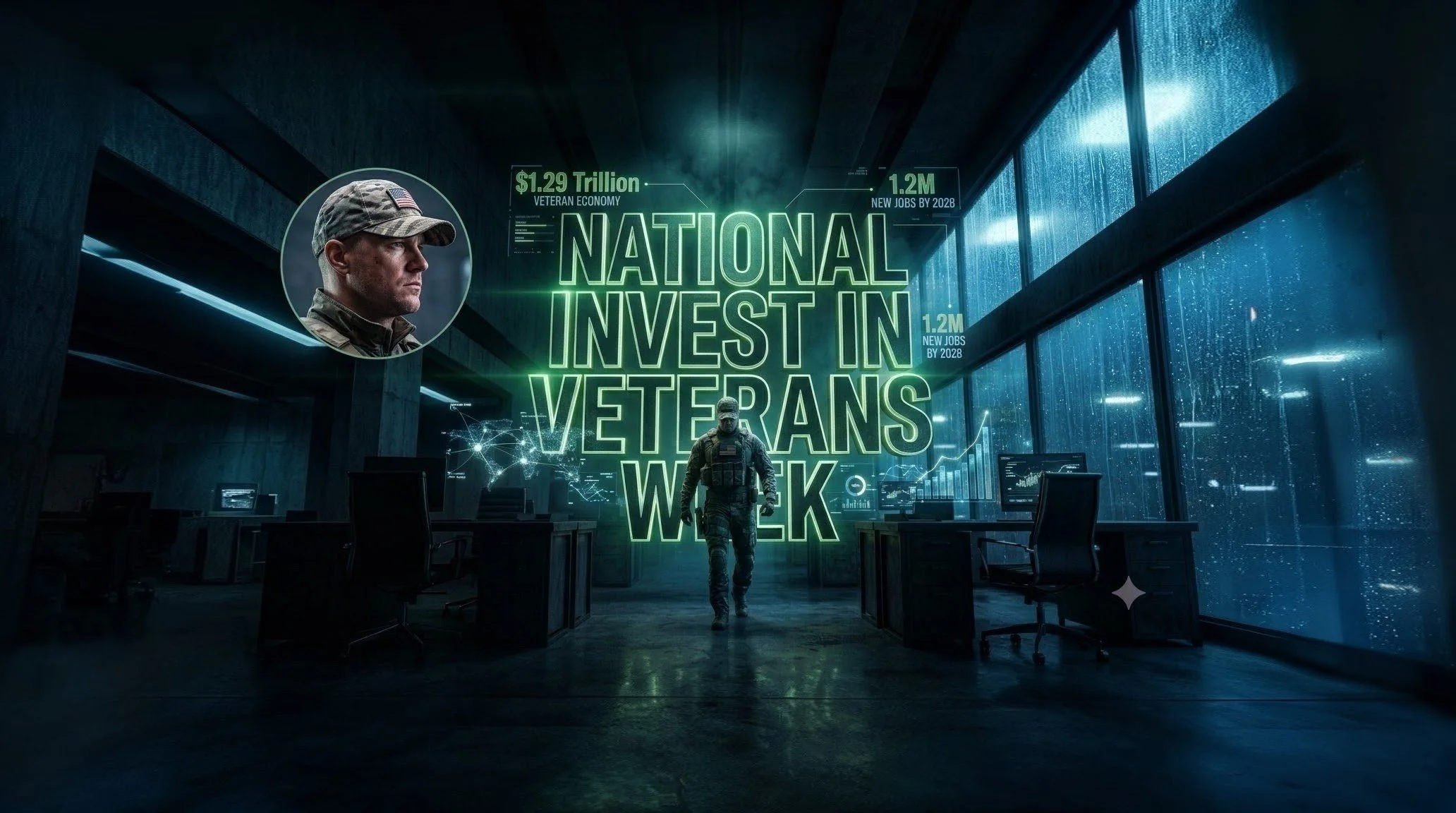
The Empirical Value of the Veteran Economy
Across the United States, veteran entrepreneurs are quietly powering local communities and stabilizing the national workforce. From roundtable discussions with the Governor of Montana to industrial warehouses in North Carolina, discover how the transition from military service to civilian business leadership forms a crucial, trillion-dollar pillar of the American economy.
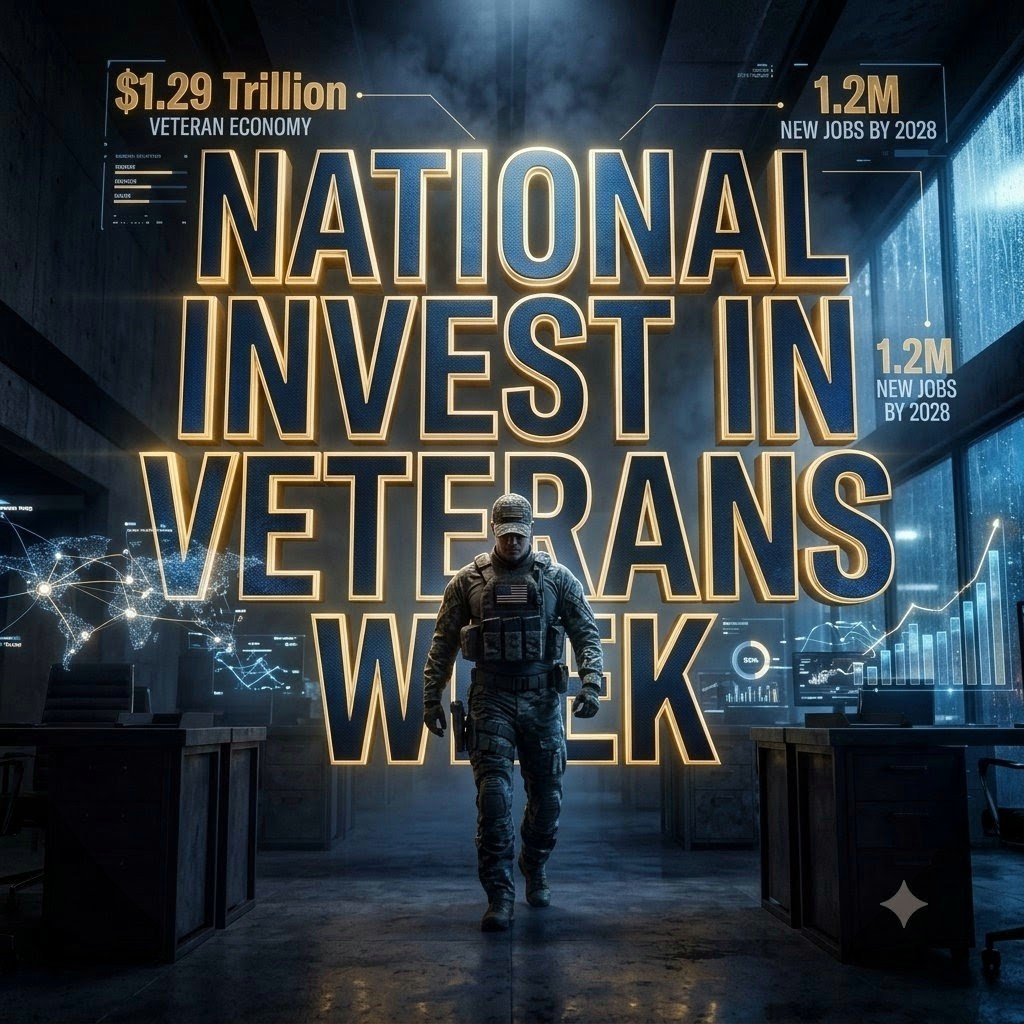
During Invest in Veterans Week, the critical role that former service members play in the national economy has taken center stage. In Bozeman, Montana, Governor Greg Gianforte recently visited Anthem Snacks, a veteran-owned meat snack company, to convene a roundtable of local veteran entrepreneurs. Gianforte highlighted that veterans continue serving their communities long after leaving the military by creating jobs and strengthening local economies.
Meeting with Anthem Snacks owner and former Green Beret Nate Kouhana, along with other local business leaders, the discussion focused on the challenges of scaling veteran-owned enterprises and recruiting former service members. Business owners like Willie Blazer of Willies Distillery and Trent McMurtrey of Scoute Arms pointed out that the rising cost of living and a lack of affordable housing in areas like the Gallatin Valley make it difficult to hire veteran employees, even when paying competitive wages.
Gianforte pointed to recent legislative efforts to ease these burdens, including a 2023 law that exempts half of military pensions from state income tax. However, local veteran advocates challenged lawmakers to increase that exemption to make the state more competitive nationally. Meanwhile, state agencies are stepping in to help, utilizing local Job Service Offices to assist transitioning service members in translating their military skills into civilian careers.
This push to help veterans transition into the civilian workforce is echoing across the country. In Charlotte, North Carolina, U.S. Army veteran George Watkins runs Stein Service and Supply, an industrial equipment company. Watkins explained to WCNC that leaving the structured environment of the military can be overwhelming, but the skills veterans possess are exactly what small and mid-sized businesses need.
Watkins noted that former service members bring leadership, discipline, and rapid adaptability to the workplace. He added that these traits are highly valuable for businesses seeking individuals who take initiative and work cohesively within tight-knit teams. By actively employing both Army and Naval veterans, Watkins emphasized that hiring veterans is a direct investment in the local community itself.
Quantifying the Backbone: Our Integration with Google Dataset Search
At National Invest In Veterans Week® (NIVW), our core objective is to take local, micro-level success stories like those in Bozeman and Charlotte and prove their macro-level impact using hard data.
To ensure the economic footprint of veteran founders is accurately measured, readily accessible, and highly visible to policymakers and financial institutions, our digital infrastructure recently reached a major milestone. The data architecture hosted on our platform has been officially indexed and recognized as an exploratory hub within Google Dataset Search.
You can view the official Google Dataset indexing of the veteran economy here.
By implementing precise schema markup on our Veteran Economic Intelligence Dashboard, our team established a machine-readable bridge to public data originating from the U.S. Census Bureau and the SBA Office of Advocacy.
The Empirical Value of the Veteran Economy
The localized leadership demonstrated by Kouhana, Watkins, and other veteran entrepreneurs serves as real-time data points in a massive macroeconomic pillar. Our newly indexed dataset, Veteran Business Economic Output, centralizes critical performance variables that shift the narrative from general awareness to quantifiable economic reality:
Aggregate Economic Impact: In the United States alone, the 2.5 million veteran-owned businesses generate an estimated $1.3 trillion in annual economic impact.
Employment Drivers: Veteran enterprises serve as consistent engines for workforce stability nationwide, supporting approximately 5.8 million jobs.
Business Ownership Rates: The United States demonstrates a high veteran entrepreneurship rate at 13.7 percent, nearly double that of other English-speaking nations.
Actionable Outcomes for the Future
Watkins pointed out that veterans have already demonstrated their ability to perform under pressure and simply require an opportunity to showcase their value in the civilian sector.
When legislative staff, corporate partners, and institutional investors search for information regarding the impact of veteran businesses, they require structured, factual intelligence to create those exact opportunities and to understand the housing and policy needs discussed by entrepreneurs in Montana.
By hosting this data in a format recognized and served by the world's primary search engine, we ensure these metrics are immediately accessible to the individuals responsible for shaping lending policies and corporate partnerships. Behind every trillion-dollar statistic and dataset index are individual veterans who take the resilience, adaptability, and technical skills learned in uniform and use them to serve their local communities. Through our expanded data infrastructure, NIVW will ensure their economic contributions remain clearly documented, utilized, and honored.
Resources & Source Material
Google Dataset Search Indexing: View the official NIVW dataset
Montana Governor's Office: Governor Gianforte Convenes Veteran Business Owners in Bozeman
WCNC Charlotte Feature: Businesses urged to support service members during Invest in National Veterans Week
National Invest In Veterans Week Staff
National Invest In Veterans Week® is an award-winning congressionally honored social impact organization dedicated to honoring and supporting our nation's veterans. Visit Invest In Veterans Week | info@investinveteransweek.com
The Frequency of Resilience: The Sonic Architecture Behind National Invest In Veterans Week®
Discover the sonic architecture of National Invest In Veterans Week®. Engineered by composer Jeff Shuford—carrying forward his family's historic The Five Satins lineage—this 7-part ambient soundscape series delivers a raw, #NoAIMusic auditory documentary. Explore how these immersive, analog tracks are specifically designed to support the mental health, focus, and resilience of veteran entrepreneurs navigating the civilian market.
Director of Cultural Partnerships, National Invest In Veterans Week®
We often discuss the veteran economy in terms of massive, undeniable data. We talk about the $1.29 Trillion in annual revenue, the 1.2 million jobs projected by 2028, and the undeniable reality that veteran entrepreneurs are the ultimate "Blue-Chip" asset. But behind the institutional capital and the corporate ROI lies a deeply human experience—one defined by endurance, isolation, and grit.
At National Invest In Veterans Week® (March 1-7), our mission is not just to change how institutional capital views the veteran; it is to support the psychological and cultural reality of the veteran founder.
To bridge this gap, the National Invest In Veterans Week® Music Group has officially released a chronological, 7-part ambient soundscape series composed by our ambassador and audio architect, Jeff Shuford.
Now available to the public across SoundCloud and YouTube, this collection is far more than a cinematic backdrop for our advocacy campaigns. It is a functional tool engineered for mental health, relaxation, and deep focus, designed specifically for the 81% of veteran founders operating in the systemic isolation of the civilian market.
The Auditory Documentary: A 7-Day Journey
Jeff Shuford has essentially composed an auditory documentary mapping the psychological transition of the military entrepreneur.
The tracklist is sequenced to mirror the 7 days of National Invest In Veterans Week®, acting as a daily anchor for founders:
March 1st | Out of Retirement | The Awakening
March 2nd | Beyond the Horizon
March 3rd | The First Signal
March 4th | Drive On | Transmission
March 5th | Drive On | Forward Momentum
March 6th | Present Help (Immersive iPad Soundscape)
March 7th | The Last Transmission
Bonus Track | Forward March
The Instrumentation: Engineering "Tactical Noir"
What makes Shuford’s approach so revolutionary is his rejection of traditional, sterile corporate music. He utilizes a methodology we refer to as Tactical Realism Noir—building soundscapes that possess immense physical weight.
Using immersive iPad soundscapes, deep Sunday Sounds synth overlays, and massive frequency stacking, Jeff constructs a literal "wall of sound." He leans heavily into cavernous effects chains—layering thick chorus, tremolo, and infinite SolaVerb delays to create deep, echoing spaces. This isn't an accident. That immense, echoing depth perfectly mirrors the "structural vacuum" that many transitioning veterans feel when they lose the built-in network of the military.
By anchoring sweeping, ethereal "Angelic" pads with heavy, guttural Juno 60 sub-bass and delicate felt piano, the instrumentation bridges the gap between the quiet isolation of the founder and the monolithic weight of the institutions we are challenging.
The Beauty of Friction: The "Drive On" Philosophy
Perhaps the most profound moment in this collection is found in the centerpiece: "Drive On."
In military culture, "Drive On" isn't about moving at a breakneck speed; it’s about endurance. It means putting one foot in front of the other when you are exhausted and unsupported. During the mastering of "Drive On," Jeff pushed the sub-frequency hardware, the overdrive modules, and the octave-up pedals so aggressively that the audio literally clipped and blew out his studio monitors.
In the era of perfectly quantized, flawless, AI-generated music, Jeff chose to keep the clipping in the final mix. Perfection is artificial. Resilience is real. The analog friction you hear in the speakers is the exact same systemic friction our veterans push through every day to secure capital and build their businesses. It is raw, it is unpolished, and it is overwhelmingly human.
The Public Response: Authenticity Over Algorithm
When we released the studio sessions to the public, the response validated our exact mission. In an era saturated by artificial generation, listeners immediately recognized the human element driving this campaign.
The rejection of sterile AI-generated audio resonated deeply, sparking the hashtag #NoAIMusic in the release's comments. Audiences praised the raw, manual execution that brought these soundscapes to life. As one listener, @UrfeeAlais-xi6tx, noted, "In a time where everything is becoming automated, it's refreshing to see music created entirely through skill and passion". Another added, "The fact that every layer was performed by hand makes this piece feel so much more personal and emotionally authentic".
The technical execution of blending "felt piano, ambient textures, and orchestral elements" into a "rich cinematic experience" served a higher purpose that the community instantly grasped. As listener @farjanamim1110 eloquently stated, "Knowing this honors veteran entrepreneurs adds another layer of meaning to an already emotional composition".
It ceased being just a soundtrack. As @JakeAndLife-c4y described it: "This feels less like a song and more like a journey through reflection, resilience, and creative expression. Absolutely stunning 🌌".
Soundscapes for Mental Health and Endurance
Building an enterprise is a lonely mission. These tracks were engineered to provide a sense of atmospheric support for the late nights, the strategic planning sessions, and the moments when the noise of the civilian market becomes overwhelming.
Whether you are an investor looking to understand the gravity of the veteran transition, or a veteran founder needing a relaxing, ambient landscape to ground your mental health and focus your next move, this playlist is your frequency.
Keep building. Keep moving. Drive on.
Experience the Official Soundscapes Now:
Stream the full chronological journey, optimized for mental health, relaxation, and deep focus.
🎬 Watch the Raw Studio Session (YouTube): Drive On | Present Help - Behind the Mix
🎧 Listen on SoundCloud: Tech From Vets on SoundCloud
🎶 Direct Tracklist: Explore the 7-Day Soundscape
#InvestInVeteransWeek #BlueChipBattalion #VeteranEntrepreneurs #MentalHealth #AmbientSoundscapes #JeffShuford #NoAIMusic


🫡Our Team
-
![A woman wearing a navy blazer with an embroidered coat of arms, gold lapel pin, and jewelry, sitting with her hands clasped, with American flags in the background.]()
President Angel Shuford
Chief Financial Officer (CFO) | Army Veteran
-
![A man in a blue suit and white shirt standing in front of an American flag against a black background.]()
Retired U.S. Army First Sergeant Kevin D. Shoun
Senior Advisor | Civic Leadership and Policy Development
-
![A woman with blonde hair smiling in front of an American flag and a black background with a logo that says 'National Invest in Veteran Owned Business Week.']()
Sara Pomposo
Chief Advisor | Audience Growth & Strategic Syndication
-
![A man in a red shirt holding a music award trophy, standing next to a framed platinum record plaque on display, with framed posters and awards hanging on the wall behind him.]()
Jim Freeman of The Five Satins
GRAMMY Hall of Famer | Brand Ambassador
-
![A man with gray hair and glasses stands behind a music stand, speaking into a microphone while using hand gestures, against a dark background.]()
Pastor Ron Henson
Social Impact Advisor | Navy Veteran
-
![A man in a U.S. military uniform in front of an American flag.]()
LTC Rickey L. Pope USA, Ret.
CO-FOUNDER | Retired Army Veteran, Retired Firefighter
-
![A man in a gray blazer and shirt posing with arms crossed in front of a city skyline at dusk, with buildings and a bridge reflected in the water.]()
Jeff Shuford
CO-FOUNDER | Iraq War Veteran & Military Spouse
-
![Three men in a discussion in an office break room with black and white geometric wallpaper. One man with a beard, wearing glasses and a suit, is talking to a bald man wearing a black sweater, who is making a gesture with his hands. The third man with dreadlocks, dressed in a blue suit and holding papers, listens attentively.]()
Drayton Florence
CO-FOUNDER | NFL Veteran & Military Brat
-
![A smiling man with glasses, wearing a green sweater over a striped collared shirt, standing with crossed arms in an office space near a window, with framed certificates on the wall behind him.]()
Erik M. Pelton & Associates, PLLC
Trademark Attorney | Veteran IP Advocate
-
![A man in a green vest with a plaid shirt and bow tie standing in front of a booth labeled 'Body Aqua' at a trade show or expo.]()
CPT Sherman WIlliams, USA, Ret.
Advisor | Retired Army Veteran
-
![Two men in business suits having a meeting in an office with a window showing a city view, discussing a presentation on a laptop.]()
Brandon Sugar
Legacy UX/UI Designer | Army Veteran
-
![A young man with dark hair styled back, light eyes, and a light beard, wearing a blue suit and white shirt, looking at the camera.]()
Mike Bicek
Creative Director | Army Veteran
-
![A small brown and black puppy sitting on a red folding chair at the beach, with sunglasses and a colorful bag in the background.]()
Private Jewel
Co-Founders Pup | Biewer Terrier
-
![A smiling man wearing sunglasses and a striped white shirt.]()
Lonnell McCall I
Sr. Spokesperson | Retired Navy Veteran
-
![]()
Celeste Everett
Legacy IT Consultant | Army Veteran
-
![Composite image of three young men dressed as a graduate, a football player, and a young man in formal wear against a stadium background.]()
Lonnell McCall II
Jr. Spokesperson | Military Brat
-
![Close-up of a young man with dark brown hair, styled back, with light eyes, a light beard, and wearing a dark shirt, standing in front of a background with horizontal lines.]()
Christopher B. Mueller
Lead Video Spokesperson | Veteran Advocate

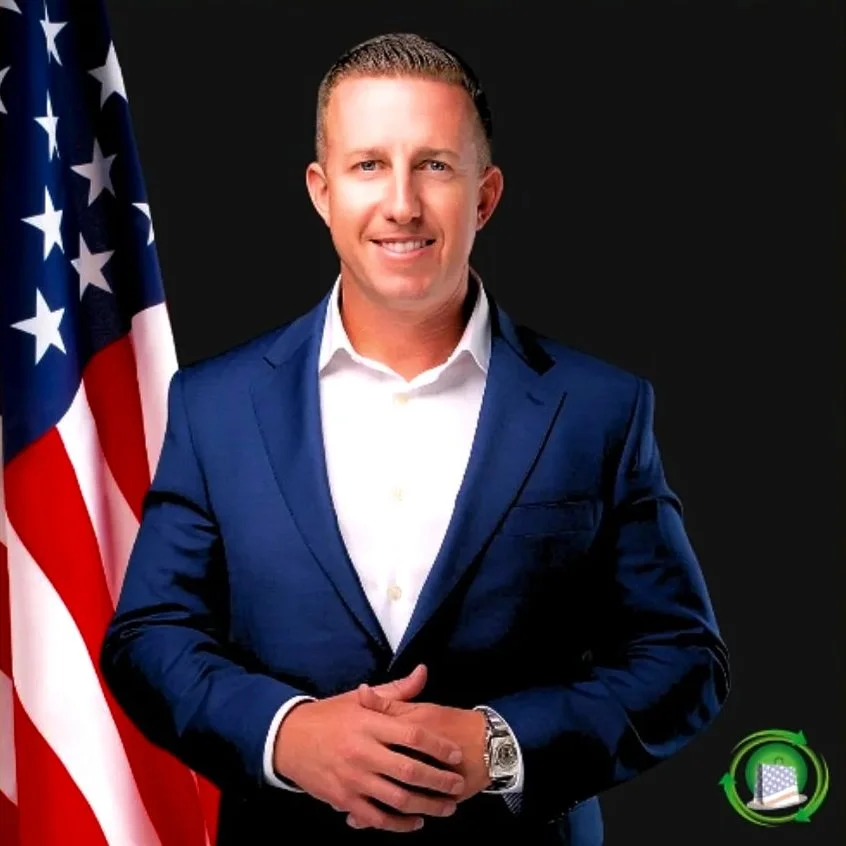






“As an educator committed to professional growth, I fully endorse National Invest in Veterans Week® for recognizing that veterans are vital economic assets who deserve tangible support in entrepreneurship and workforce development.”